 Google is walking the walk when it comes to promoting YouTube personalities.
After hearing from agencies that it was not acting swiftly enough to tout its own programming, the video platform embarked this month on a “massive” TV, print and out-of-home campaign starring several of its high-profile personalities (YouTube calls them creators) that target Millennial audiences.
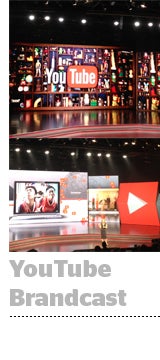
YouTube continued the narrative at its digital newfront “Brandcast” Wednesday night, where a couple thousand advertisers convened at Madison Square Garden Theater.
In between the monologues and musical montages, YouTube creators like fashion and beauty personality Bethany Mota, who has amassed more subscribers than mainstream stars like Lady Gaga, took the stage to share how YouTube turned them into household names (and subsequently acquired brand partnerships, such as retailer Aeropostale, which launched a Bethany Mota design collection).
“YouTube connects us directly to consumers,” said Frank Cooper, Pepsi’s CMO, who spoke onstage about the beverage company’s use of the platform. “People are spending more time with online media than traditional media and relying only on TV [to reach your audience] is not a sane idea. We started our investment in YouTube back in 2005 and increased that 50% in the last year alone.”
Robert Kyncl, VP and global head of content and business operations at YouTube, noted a “doubling down” on YouTube by brands and agencies. He added average monthly views for paid and earned media on the platform have grown by 70%.
YouTube creators and their fans have attracted sizable investments. Kyncl pointed to Disney’s some $500 million purchase of YouTube network Maker Studios.
Naturally, Google intends to capitalize by offering special inventory around its best-performing stars (and the measurement to show just how well that content performed) via a program called Google Preferred.

“We will shine a light on our best and most popular content this year,” Kyncl added. “We have listened to your needs. You have told us, ‘YouTube is hard to buy’ with so many choices. Google Preferred will help you navigate and access the top 5% of content on YouTube based on popularity and engagement.”
Johnson & Johnson, Heineken and agency DigitasLBi have all signed on to secure audience guarantees through Google Preferred, according to Kyncl. One of the reasons, according to Google’s Margo Georgiadis, sales president of the Americas, is the level of engagement Google guarantees.
“YouTube is now the no. 1 place [for 18-31-year olds] to go to learn about a product or passion that interests them,” she claimed. “They are four times more interested in watching ads on YouTube than anywhere else, and they’re much more open to your messages.”
In addition to Google Preferred guarantees, Georgiadis noted a new availability for ad partners to measure brand interest on YouTube based on real-time searches on-site.
Speaking of search, YouTube’s SVP Susan Wojcicki, referenced Google Video, which in 2005, “was our [first] homegrown effort to build an online video ecosystem [and video search engine] but we had no users, no content and no idea what people would upload and watch.”
Google acquired YouTube shortly after in 2006 for $1.65 billion, which helped answer the viewer and content question.
“People ask me why I was inspired to make the shift three months ago [from her most recent post as Google ads chief],” Wojcicki said. “I joined YouTube because I believe video is an amazing medium for sharing ideas, information and the stories of our lives,” she said. “I wanted to play a key role in that revolution, still work with advertisers and help ensure a thriving ecosystem. That work has just begun.”
See the video.