

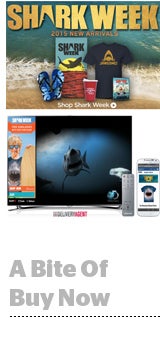
 Despite the doom and gloom around declining linear TV viewerships, networks like Discovery Channel still score on popular annual programming events like Shark Week.
The network claimed 2014’s Shark Week was its biggest ever, drawing 42 million viewers in the course of the week, which spurred its decision to expand the weeklong summer event, which concluded on Sunday, to one extra weekend in August.
Multiscreen activations are a big part of it.
“We’re always testing co-viewing opportunities, since Discovery tries to engage the user in more ways than just the on-air experience,” said Christine Wacker, director of commerce partnerships and consumer products at Discovery Channel.
For the second year in a row, Discovery Channel launched a multiscreen campaign to drive viewers who were tuning in on connected TVs or their mobile, to Discovery’s online store, where products run the gamut from standard swimwear to branded memorabilia.
In the 2014 season, it worked with Delivery Agent, a commerce technology that helps companies like Sony and Visa embed shoppable features into their media.
Discovery and Delivery Agent activated shoppable overlays adjacent to programming for people viewing Shark Week on Samsung TVs.
If a viewer wished to purchase an item, they were prompted to enter their mobile number, triggering a web-based link to the branded Shark Week store. The network found 91% of viewers who forwarded a shopping link to their mobile device clicked through to the store’s landing page.

This season, Discovery has expanded the connected TV campaign to Twitter to test out the new “Buy Now” functionality, which lets brands and media companies embed shoppable buttons directly within tweets.
“We found even if viewers are excited about what they’ve just seen or read, you only have their attention for about 10 seconds to get them to click or take an action,” Wacker said. “The easier we make it, the better the conversions. [Twitter was a] great way to test if people will instantly react to something in their feeds.”
Discovery has more than 3 million Twitter followers and 260,000 Shark Week followers, so Buy Now seemed like a logical engagement opportunity.
Although Discovery declined to share details about how it segments its audience, Delivery Agent CEO Mike Fitzsimmons said it zeros in on viable targets by combining viewership data with social and purchase data from a CRM system.
Discovery also uses data to determine which products to offer in its online store.
For instance, Discovery kicked off this season’s programming with a promo where Billy Idol proclaimed, “It’s Jawsome!” and the network sold co-branded t-shirts and merchandise featuring the phrase.
“We found our generic shark stuff did not perform as well as products that were more on-brand or geared toward our marketing campaign,” said Wacker.
Discovery is evaluating the success of its multiscreen campaign on engagement metrics, but conversions are equally important.
“Sales is obviously the biggest barometer of success, but you don’t want to consider something as new as [Buy Now] a failure if you didn’t drive sales immediately,” said Wacker, who predicted it would be at least a year or two before it sees measured sales results from transactions on mobile.
Last year, Discovery had great engagement with first-click for its connected TV campaign, so it’s looking to bring people deeper through the purchase funnel and examine if users who clicked once came back or clicked again.
Discovery is also factoring in the impact of programming daypart on audience receptivity. Wacker noted that daytime tune-in improved substantially for Discovery last season, which indicates more people were watching on multiple devices, perhaps even during the work day.
“At the end of the run, we’ll compare it to last year’s results and see if there were behavioral shifts,” she said. “We want to see if daytime continues to grow or if that attention shifts back into prime time. These data points help us make more informed decisions.”








