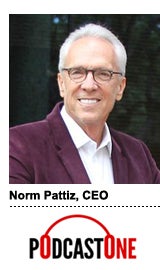
 Large networks like CBS, iHeartMedia and Scripps have been vocal about their recent investments in podcasting, and Hubbard Broadcasting joined the chorus earlier this week by acquiring a 30% stake in podcast network PodcastOne.
PodcastOne is an online hub that houses 200 shows, including podcasts from personalities such as Adam Carolla, Snooki, Dan Patrick, Shaquille O’Neal and Steve Austin. PodcastOne has contracts with all the programs on its network and owns all, or a portion, of those shows for a prescribed period of time. The firm also owns exclusive rights to 99% of sales, marketing and represented rights for the podcasts it hosts.
PodcastOne offers live, pre-recorded and dynamic ads to its clients and, in aggregate, its network delivers roughly 400 million advertising impressions per month.
The company, which started three and a half years ago, did $2 million in business in its early days. This year, PodcastOne CEO Norm Pattiz anticipates 10 times that amount.
According to Pattiz, the value to advertisers is that distribution to audiences is “far simpler than in traditional media.”
“We have the opportunity to go directly to the consumer on subjects they’re interested in, and it’s available to them whenever they want,” he said.
But in a fast-growing industry, measurement remains a problem, and networks are innovating to offer clients tangible metrics.

AdExchanger spoke to Pattiz.
AdExchanger: What’s driving interest in podcasting?
NORM PATTIZ: When I was in the radio business, for 25 years there was never a down year. Listenership was growing, and so was revenue. But lately … radio is at best flat and in some cases down. And there’s more consumption done through methods that don’t require listening to a broadcast radio station.
Broadcasters should embrace it because it’s just another form of distributing a radio or audio product. Look at what’s taking place in television. Network television is becoming a tougher business; people are consuming it in different ways. CBS has come out with a podcast platform, and iHeartMedia has said they’ll be moving into this area. The deal made by Scripps to acquire MidRoll [a podcast advertising network] made it clear that this is a space that’s going to get a lot of attention from strategic investors.
Do you typically sell to traditional or digital audio buyers?
We’ve been focusing on the $17 billion of traditional audio ad spend. We often go directly to the digital side, because that’s growing rapidly. A few years down the road, they’re going to meet up. But we’ve very conscious of going into the digital side because of the growth in mobile. About 70% of our consumption right now is happening in mobile.
There’s an abundance of programming out there. We’ve got 200 programs on our network, and we could have 200 more in a month. But there’s no point in adding more programs than we have the ability to sell right now. Since there is a large partnership aspect to what we do, we have a responsibility to sell out inventory for our partners before we start increasing the size of our network.
What’s the opportunity for RTB in podcasting?
It’s very early for that. It’s been tried, and it has never been successful. Will it be successful? Sure, but not until podcasting establishes itself firmly in the minds of advertisers, specifically brand advertisers, that it’s valuable.
If you sell programmatically, advertisers are going to buy on thousands of podcasts. When you look at the average audience of a podcast on iTunes, you’re talking about some podcasts that reach 100 people. A major chunk of podcasts come from backyard podcasters that are talking to their friends. If you go out and buy that programmatically, it’s impossible to get to all of the hosts or producers of those shows to tell them what a direct response or brand advertiser needs. Will it come eventually? Sure, but the business isn’t big enough yet.
Who are your advertising clients?
It’s major advertisers that are using network radio, and big advertisers that are involved in mass appeal digital radio. We’re very engaged in the automotive side, the retail side and consumer products. All the things one would expect if they looked at a network television show or listened to a network radio show. In many cases, it’s advertisers looking for cutting-edge opportunities in digital.
What metrics do you offer?
We use digital measurement to provide audience estimates to our advertisers, and we also use survey data. We do survey data with Edison Research regularly throughout the year to get information directly from our audience for the programs on our network.
We’re more interested in impressions than uniques and click-throughs. We’ve used a number of third-party research and tech companies to provide a solution that can take raw download data and convert it to an impression. We chose that method because we couldn’t find any consistency among suppliers when looking for purely digital solutions in the space. Our partner that provides our download information is Edgecast, which is owned by Verizon. Our confirming technology is WideOrbit, who recently bought Abacast and Castfire.
How are you leveraging dynamic ad insertion?
Dynamic insertion lets us add a pixel for the purposes of measuring audience size. It’s valuable in regionalizing and making copy date-sensitive. On the first of the year, we started providing up-to-the-minute, 60-second newscasts at the close all of our podcasts. We did the deal with Associated Press, and they provide a variety of audio news feeds every hour of every day. Dynamic insertion lets us grab the latest news at the time of consumption, so we’re able to extend listening through the post-roll.