If you want to know what privacy regulators think about online advertising, it’s not a mystery. Just listen to what they’re saying.
Federal policymakers, state attorneys general and California’s new privacy watchdog are all hammering the same points: protect kids, honor opt-outs, back up your privacy promises, stop collecting more data than you need and don’t make it a hassle for people to exercise their privacy rights.
“The expectation is that consumers shouldn’t have to jump through a bunch of hoops,” said Tom Kemp, executive director of the California Privacy Protection Agency, speaking during the IAB’s Public Policy & Legal Summit in Washington, DC, last week.
“The guidance I have for any business,” he added, “is to walk a mile in the shoes of a consumer.”

No kidding
And when that consumer is a kid or a teen, regulators are intolerant of any ambiguity. Children’s privacy is where they’re drawing some of their brightest lines – and they’re increasingly skeptical of companies that insist they “don’t know” when minors are using their products.
That excuse is wearing thin, said Delaware Deputy Attorney General John Eakins.
Eakins and his team will ask companies outright, “Do you process kids’ or teens’ data?” and the answer is always, “Oh no, of course not.”
“Yet we know for a fact that the people using [their project or service] are actually kids and teens,” he said.
It’s implausible for companies to claim they lack “actual knowledge” of who’s on their platform – the trigger for children’s privacy obligations under COPPA – when their business model depends on selling hyper-specific audiences, Eakins said, like “an adult who’s between 25 and 30 years old and likes to read The New York Times and enjoys having a prime steak.”
You can’t have it both ways.
“Putting your head in the sand is just not going to stand up anymore,” Eakins said. “I’m not sure what the case will be that breaks through, but, from our perspective, it’s going to bring a lot of inquiry.”
 When someone opts out, believe them
One area where there’s been more than just inquiry is into how companies handle opt-outs – especially the Global Privacy Control (GPC), a universal opt-out mechanism that lets consumers automatically opt out of data sales and sharing across sites without having to make individuals requests to multiple controllers.
Although some, like privacy attorney Alan Chapell, warn that the GPC could have anticompetitive side effects if browsers turn it on by default, Kemp described the signal as “incredibly important” because it enables “privacy at scale” without the maddening task of having to opt out of tracking one company at a time.
“Oftentimes, exercising your privacy rights is a never-ending set of chores,” Kemp said.
He also made it clear that honoring the GPC isn’t a side note; it’s the through line.
The majority of California’s recent enforcement actions, including Disney (a $2.75 million fine), Healthline ($1.55 million), Tractor Supply ($1.35 million) and Jam City ($1.4 million), involved opt-out failures, including ignoring GPC signals, misconfigured opt-outs and inadequate consumer choice mechanisms.
From here, the pressure will only increase.
In February, the California Privacy Protection Agency launched an Audits Division and hired a chief privacy auditor, Sabrina Ross, to lead it. Before coming to the CPPA, Sabrina spent nearly six years as the privacy and AI policy director at Meta and was the global head of policy at Uber before that.
The division plans to conduct technical tests in the wild to make sure that the GPC and other preference signals are being honored in live environments and not just on paper.
No love for mixed messages
But getting the mechanics right is only part of the job.
Companies also need to make sure their data practices line up with what they’ve told people in their privacy policies. Offering privacy controls doesn’t mean much if, behind the scenes, you’re collecting, sharing or retaining data in ways that contradict those promises.
The Federal Trade Commission’s recent case against dating app OkCupid and its parent company, Match, is a good example of what happens when promises and practices drift apart.
Although OkCupid’s privacy policy described limits on who could access user profile photos and other personal information, the company shared that data with a third-party anyway. There was no fine, but OkCupid and Match are now subject to 10 years of compliance reporting and privacy monitoring.
“If you make privacy promises to consumers, you’ve got to hold the line on those,” said Ben Wiseman, an associate director of the FTC’s Division of Privacy & Identity Protection. “Don’t make promises that you’re not going to be able to keep.”
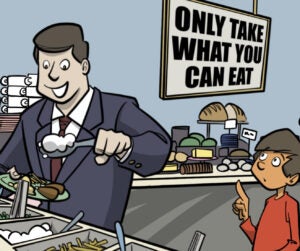
Portion control
And those promises don’t just cover where data goes, but also how much data companies gather and how long they retain it.
Most new state privacy laws include a data minimization provision that says companies should only collect personal data that’s adequate, relevant and reasonably necessary for the purposes they’ve disclosed to people.

Which is just a wordy way of saying: Be transparent.
“Take a look at what your privacy policy is saying,” said Kashif Chand, chief deputy attorney general in the Data Privacy & Cybersecurity Section of the New Jersey AG’s office.
If a privacy policy is vague and doesn’t clearly state what a company is doing with data, then people have no hope of understanding how the data is being minimized. “They both flow together,” Chand said.
And speaking of flows, Delaware Deputy AG Eakins stressed that the minimization obligation doesn’t stop with the first party; it has to travel with the data as it moves through the ad tech supply chain, and there also needs to be a contract to prove it.
“When we’re talking about a long value chain of people passing personal data, what have you contracted?” Eakins said. “Are you making sure that the person you’re handing that data off to is also going to be bound by those same terms?”
Tools like the IAB’s Multi-State Privacy Agreement aim to make that process easier by baking data minimization and purpose limitation language into contracts across the ad tech ecosystem.
But even with standardized contracts, the target keeps moving. The standard for data minimization isn’t consistent from state to state, which is a challenge for controllers, acknowledged Chandler Crenshaw, assistant attorney general and consumer privacy unit manager in the Virginia’s AG office.
Maryland, for example, requires that collection be “strictly necessary,” while neighboring Virginia – just across the Potomac River, Crenshaw quipped – uses a “reasonable” test.
“If we had a signal from Congress,” he said, “this is one of the areas where I think it would be good for a decision to be made.”