When I first started at AdExchanger in 2014, I was a true noob.
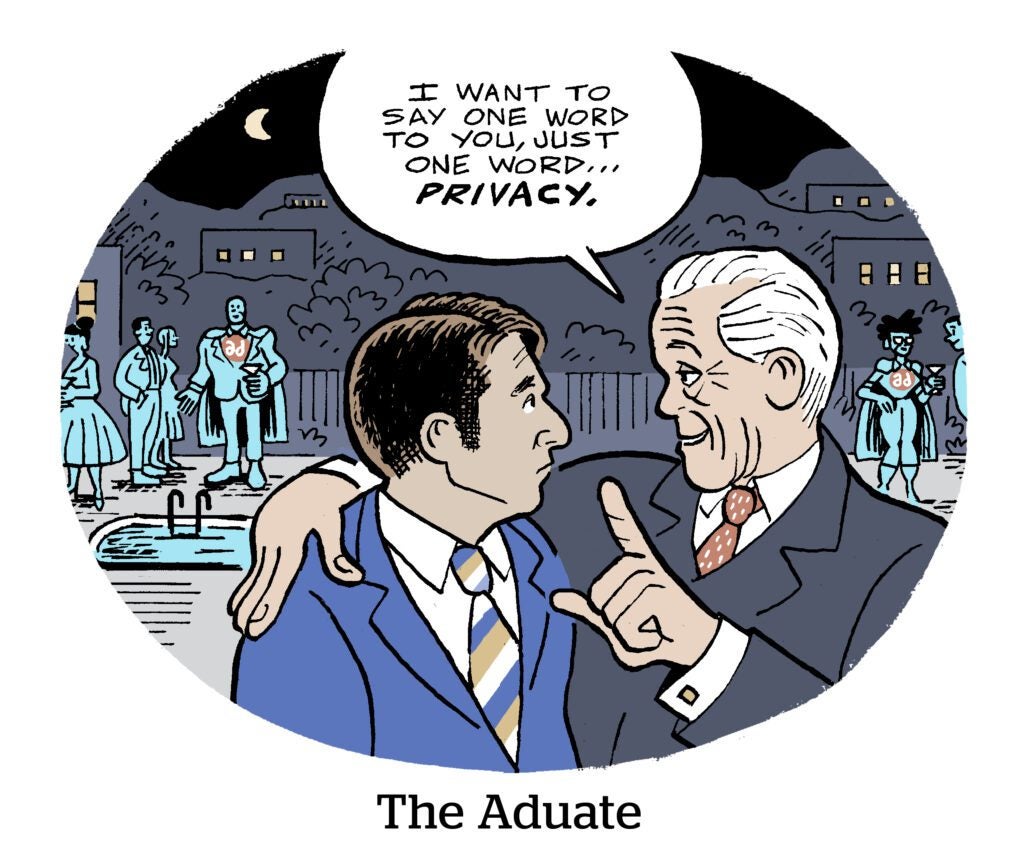
If I took an intro briefing call with a tech company and the person I was talking to said that their solution was “privacy safe,” I didn’t know to press any further. I accepted that “fact” at face value.
Cool, yeah, privacy safe.
But I’m (much) older, (somewhat) wiser and (definitely) more cynical now.
I’ve taken quite a few briefings with a heck of a lot of technology companies over the years, and today, when I hear someone say in passing that their solution is privacy safe, I try not to let them gloss over the point.
Yes, but how is it privacy safe?

Watch out
To be fair, talking about privacy restrictions can be a downer.
As one speaker at the IAB’s Annual Leadership Meeting in January apparently said on stage, “I’m not going to talk about privacy. Because privacy is boring; it makes our eyes glaze over.”
But if there’s one thing that can make one’s eyes pop open, it’s unwanted attention from the Federal Trade Commission or an enforcement letter from the California Privacy Protection Agency (CPPA).
Regulators are increasingly curious – and educated – about the details.
Although the CPPA’s annual budget is a rounding error for the likes of Meta and Google, its sole purpose is to protect the privacy rights of Californians. So you can expect it to be dogged in its efforts.
The FTC also just recently announced a new Office of Technology to help the agency keep pace with rapid changes and developments in the digital marketplace, including by developing new investigative techniques and advising the commission on policy and research.
 The Hill has eyes
In other words, surveillance can be a two-way street.
Regulators are making it their business to poke around the inner workings of data-driven online advertising.
Take Kochava. It’s in the midst of legal wrangling with the FTC over allegedly facilitating the sale of sensitive location information. Kochava argues that the FTC’s case doesn’t have legs, in part because it believes that the commission’s accusations are overly broad and don’t point to a specific law or regulation that prohibits its business practices. The case is proceeding after a judge in Idaho denied Kochava’s motion to dismiss last month.
Be that as it may and regardless of the outcome, ad tech is under the microscope.
And there’s no doubt that enforcers will continue to make inquiries and ask questions. Questions like, “How, exactly, is your solution ‘privacy safe’?”
Be worthy of trust
But that’s a question companies should be able to answer in multiple contexts.
Regulators will want to get into the weeds, but regular people deserve a consumer-friendly (human-friendly?) explanation of how and why their data is being collected.
Simply saying, “Don’t worry, you can trust us, we do things in a privacy-safe way” won’t cut it, regardless of who’s being addressed.
Sharing enough detail without being overwhelming is a difficult balance to strike, and there’s no perfect answer. But one thing is for certain: Privacy platitudes are for hacks or for those with something to hide.
Agree? Disagree? All opinions are welcome. Let me know what you think. Drop me a line at allison@adexchanger.com.