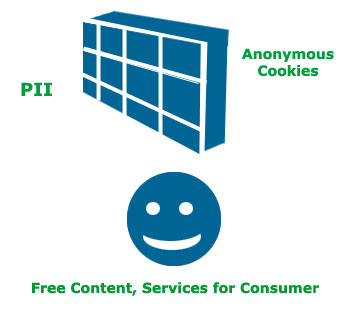
 Another privacy piece on the behavioral ad network business has been launched – this time by The New York Times’ Stephanie Clifford. In her piece entitled, “Ads Follow Web Users, and Get Deeply Personal,” web ads are considered “Orwellian.” Good god. That’s over the top and reminiscent of other recent pieces in the media (like here).
There remains a significant need to explain PII and what anonymous cookie tracking is, and the Chinese Wall between them – and that the sky is not falling on consumers.
Are we going to start “outing” restaurants and gas stations for taking credit cards? I mean what goes on behind the counter, anyway? Aren’t they handling even more potentially threatening, “Orwellian” information? Is the world supposed to be an open and transparent barter system in the eyes of privacy advocates?
- “Here’s my sack of wheat. I’d like to buy a laptop, please.”
- “Sir, we don’t offer laptops. We offer the parts. You wouldn’t be able to see inside the laptop after all. We could have a Lo-Jack in there or something.”

Efforts by the IAB and other acronyms are first steps in trying to inform about legitimate privacy concerns. Still, companies like Axciom and Datran Media need to be able to say for articles such as today’s in the NY Times that they follow the clear and precise X, Y and Z guidelines of the IAB/NAI/etc.
If a consumer, the media or the government has a question about how anonymous cookie tracking works, the interactive ad industry should agree on it and then make it available in clear terms. In addition, benefits to web advertising need to be explained and championed such as access to an incredible range of content and services that, unfortunately, many in Congress will never use or understand.