 The convergence of creativity and technology is shifting the dialog between consumers, agencies and brands.
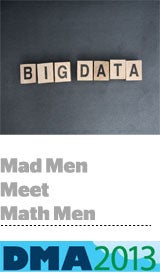
An on-stage discussion at the DMA 2013 conference in Chicago attempted to chart that shift by answering the question, “Does data drive the big idea or vice versa?”
On the panel were Doug Bryan, a principal engineer at RichRelevance; Ben Liang, a senior engineer for ChoiceStream; Michael Miller, CMO for Epsilon Agency Services and Michael Schaffer, consulting CTO for Winterberry Group. The session was titled “Mad Men + Data Specialists: When Two Worlds Collide.”
“The ability to narrow the focus for creative [using data] is critical and will lead to the ability to have successful, award-winning campaigns,” Miller remarked. “The interesting place we’re at today is our ability to take massive amounts of data and turn that into a real signal that is truly actionable. Data has allowed us to find newer and more narrow places to focus [creative] impact.”
Miller, who formerly held top-level positions at MRM Worldwide and Grey Global Group, also dabbled in technology consulting and enterprise resource planning, which left him “totally conflicted,” he joked. The interesting phenomenon in the market today, he said, is the shift from the mass world of “.com” to the hyperpersonalized “.me” revolution.
“The [consumer] may claim they don’t want anyone to have their data, but at the same time, say they want a personalized experience wherever they are in the moment in their day,” Miller said. At Epsilon Agency Services, Miller said the response to brands is, “You need to create empathy.” Using data, brands are looking for ways to help consumers feel more emotionally connected to the brand or their mission. Other times, it’s about providing tools to utilize the brand directly.

One such example was evident in a panel led by consumer goods company Procter & Gamble that detailed its journey to apply CRM data across segmentation, targeting, offers, content and loyalty efforts. P&G Everyday, a personalized digital portal for consumers, blends product information, access to offline coupons, reviews and recommendations, content and other forms of utility for the P&G shopper.
Wouter Coox, P&G’s senior manager of interactive and direct-to-consumer marketing for western Europe, said “We are able to personalize content and [create] a call to action” based on big data insights derived from the P&G Everyday platform. “The more data you have about consumers, the more relevant you can be in communication.” He said P&G sees a $3 return on every marketing dollar because of its data-driven approach to personalization.
ChoiceStream’s Liang said brands must overcome technological challenges in partnership with their agencies.
There are big roadblocks in the multiscreen world of media. “We primarily work on RTB exchanges that are primarily focused on display,” he noted. “Display is an important part of the media mix, but it is increasingly being pushed to the fringes. There are enormous technical challenges that stem from mobile and tablet and video.”
The technological and creative underpinnings of a campaign are often fragmented among third parties, which “can create a lot of inefficiency. Both sides need to understand the other’s form of creativity.”
That trickles down to the initial client meeting, another question that arose during the panel discussion. Specifically, who gets a seat at the table in client meeting No. 1?
“The technology guy is allowed to say, ‘That is expensive,’ and ‘That is hard,’ but you don’t give that guy the veto power,” Schaffer remarked. “Conversely, you don’t ever let the creative guy say yes [without input from the data insights side]. I look to the creative guy to answer, ‘What is the brand trying to accomplish?’ The purpose and strategy usually doesn’t come from the technology side.”
When asked to define “mad man” and “math geek,” Miller said, “A modern mad man is somebody who understands contextually how to build digital ecosystems that people engage with and want to share with others and advocate. When these worlds come together now, it’s with deep, empathetic ideas that transform channels with powerful data that points to exactly what the customer is looking for.”