“Data-Driven Thinking” is written by members of the media community and contains fresh ideas on the digital revolution in media.
Today’s column is written by Chris Smutny, vice president of strategy at Sojern.
As a marketer, my goal is to make ads as relevant as content so consumers say, “Wow. That was really helpful.” This would satisfy dual goals of increasing my brand’s sales and delivering value to the consumer via advertising.
This shouldn’t be mistaken with dressing up advertising to look like content. Sponsored content is one of the hottest online advertising trends right now, but unfortunately, many are engaging in a good-intentioned but dangerous race to hide advertising as content. If the industry continues down this path at its current speed, I fear a severe consumer backlash and a new regulatory landscape.
Making an ad as relevant as content is very different from making an ad look like content. The former is a legitimate aspiration and benefits both consumers and advertisers. The latter is disingenuous in its goal and methods, specifically in the way ads are disguised as content. While it serves the first objective of increasing brand sales, some native advertising achieves it through deception.

In America, we have an almost mythical respect for certain protected rights and spaces, like the right to free speech, the separation of church and state and the divide between the editorial and business sides of the press. The wall separating the editorial and business departments has arguably never been more porous than it is today, even at longer-lived publications like The Atlantic and The New York Times, as well as newer outlets, such as BuzzFeed and Huffington Post.
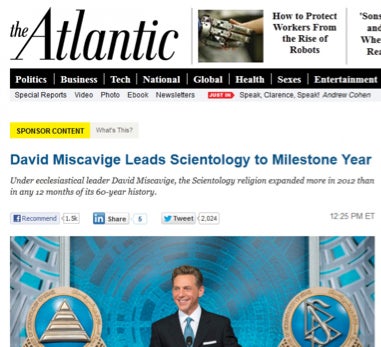
For example, consider this piece below from The Atlantic. Many in the advertising industry would clearly note the “Sponsor Content” tag above the Scientology “article.” But we are not the general population. Our plus-ones, children, parents and friends outside the industry may not be as informed – or cynical – as we are.
Proponents argue banners are broken and note the problem with ad blindness. The answer to ad blindness isn’t to deceive, but to make a better ad. Companies like Criteo demonstrate that by showing a more relevant offer to the consumer, it can increase interaction rates dramatically over traditional approaches.
Other arguments: Many native implementations are useful to consumers, drive awareness of great products and generate revenue for terrific companies. I get that. But that’s not always the case.
The IAB’s self-regulatory guidelines say, “Regardless of context, a reasonable consumer should be able to distinguish between what is paid advertising vs. what is publisher editorial content.”
And as an industry, I think we are failing to meet this threshold. We should have learned from recent history and the early days of search, when companies did their best to make the divide between the algorithmic and paid listings as faint as possible. At one point, this dividing line became too faint until the FTC stepped in.
Will we learn from the past and prevent a similar fate for native advertising? I hope so. The last thing I need is for my mom to tell me she’s become a Scientologist after reading an excellent article about David Miscavige in The Atlantic.
Follow Sojern (@Sojern) and AdExchanger (@adexchanger) on Twitter.