“Data-Driven Thinking” is written by members of the media community and contains fresh ideas on the digital revolution in media.
Today’s column is written by Alessandro De Zanche, an audience and data strategy consultant.
The accusation that Apple is using privacy as a Trojan horse against “the rest of the world” with the goal of building an advertising empire is so petty. In fact, I can’t help but consider that charge as hyper-partisan politics driven by not-so-hidden agendas.
The digital advertising ecosystem can be split into two: those who own assets and those who don’t.
Digital advertising and the widespread adoption of the programmatic open marketplace have, for more than a decade, handed over control of media owners’ and advertisers’ assets to companies that don’t own any.

These companies have no relationship with the audience, don’t advertise and aren’t directly receiving any data from the audience. They don’t create any content or own any consumer-facing digital environments. Meanwhile, other companies (i.e., social media platforms) do own assets, but they need much more data than just their first-party data to build a full profile of the user. And then there’s a third cohort of companies that only care about what fuels their revenue channels: the sale of data and ad slots.
While a good part of ad tech is evolving and embracing the future, it is many of those companies without assets, which don’t provide much value to the audience, or those in constant need of more data that are the ones attempting to drag the privacy debate into the mud. Not Apple.
On the contrary, Apple is disrupting old business models that refuse to evolve or die. And the entities affected are fighting back with what is left: weak narratives and conspiracy theories.
Regulation and policy shape privacy
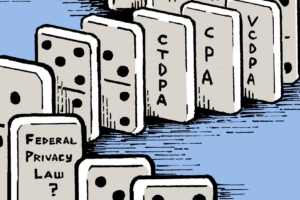
The demand for privacy is affecting the digital advertising sector in two areas: regulation and policy.
Regulators, although becoming increasingly more effective, have so far failed to enforce the law consistently and at scale.
The writing for RTB and TCF is clearly on the wall. Yet regulators are playing a seemingly never-ending tennis game, where nobody wants to win or lose, but rather buy time and see who will take responsibility for ending the back-and-forth, and when.
Then there is the policy side, where Google and Apple are approaching the issue in different ways, with similar future end results.
Within its own environment, Apple is taking the destiny of privacy and user experience into its own hands by not allowing the sharing of data across third parties, unless the user allows it.
It is not a mad, wacky idea: a company needs consent from the user to be able to share collected data with other companies. Simple.
We’re not living in a perfect world
In an ideal world, Apple’s focus on enforcement wouldn’t be necessary. Data collectors would properly and explicitly communicate options and respect the user’s choice, rather than making it harder than ever to provide or deny consent. Also, in an ideal world, timely enforcement would be the norm.
In the real world, it is not happening this way.
Some digital advertising players believe that a company doing the right thing to protect its audience’s experience and privacy shouldn’t do so if that action generates advantages in other areas. Apple cannot be preemptively condemned for doing the right thing based on what might happen in a hypothetical future.
Take Bloomberg’s perspective, for example: “Apple’s growing foray into advertising [makes it] hard to reconcile with a commitment to walling off private information.”
Are we assuming that great digital advertising and privacy cannot go together?
Apple’s responsibility
So what should Apple do?
Should it give up on its audience and fail to protect the user experience in its own environment – even if protecting the user experience means simply making sure the same concepts present in existing regulations are properly followed?
Should it enforce privacy but ban advertising in its own environments “just in case” someone will spread conspiracy theories about the company’s motivations?
As someone who has long been highly critical of the way media owners have handed over the user experience to ad tech only to see it degrade (and paid the price for that degradation in many ways, like the rise of ad blocking, for one), I cannot help but agree with Apple’s approach.
I am confident Apple will set a new standard and help redefine the digital advertising experience beyond Apple’s environments.
If Apple innovates in the advertising field, too, the net value for the industry will be much higher than what it (supposedly) lost in (non-consented) data.
Follow Alessandro De Zanche (@adzandads) and AdExchanger (@AdExchanger) on Twitter.
For more articles featuring Alessandro De Zanche, click here.