Startups keep cropping up to compete for TV ad dollars in the messy middle between digital out-of-home (DOOH) and connected TV (CTV).
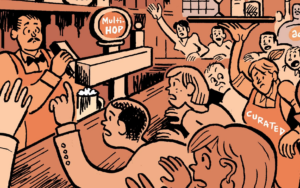
Loop Media, Atmosphere TV, Taiv and GSTV are just a few examples of companies selling video ads in public places (bars, restaurants, gas stations, etc.) by pitching a combination of mass reach and targeting.
The latest to pop up in my inbox is BarBoards, an Austin-based startup that launched in February as a DOOH tech platform that runs ads on screens in restaurants and bars throughout Texas.
If that scope sounds rather narrow, it is.
According to BarBoards, it differentiates by super-serving a very specific audience: young consumers between the ages of 21 and 35 who watch sports, have disposable incomes and live in the Lone Star State, says Co-Founder and CRO Ben Woods.

In other words, people often found in a Texan sports bar.
This target audience explains why most of its roughly 45 brand clients hail from categories such as alcoholic beverages (Milam & Greene bourbon, for example), tourism (Visit San Antonio is also a client), consumer-packaged goods (such as Rev Gum), sports gambling and food service.
BarBoards, which is planning a national expansion to bars beyond Texas next year, is wooing more advertisers with the promise of reach, measurement and low costs.
To do so, it straddles the blurred line between CTV and DOOH – an increasingly common tactic among DOOH companies that want to win ad dollars by focusing on their similarities with pure-play streaming and TV.
Fitting the CTV mold
The struggle that all DOOH companies competing for TV ad dollars face is explaining to prospective buyers what, exactly, they are.
Out-of-home TV doesn’t fall cleanly into either the CTV or DOOH bucket, which makes it a gray area for buyers. To attract demand to this relatively nascent channel, vendors in the space are looking for the right way to describe themselves to brands. Some refer to themselves as CTV OOH or OOH TV in the bidstream, while others go for premium video or just plain TV. As for BarBoards, it hasn’t settled on a specific label.
“Our goal is to stay in this gray area for now,” Woods said.
DOOH companies have a commercial incentive to present their inventory to buyers as CTV – or as an extension of CTV – because brands want what they consider to be premium placements, which is often long-form content that can hold an audience’s attention.
BarBoards is selling brands on inventory that behaves like CTV but costs much less. According to Woods, brands can get targeted video inventory for a quarter of what they pay for linear TV.
Digital billboards, meet bars
But linear advertisers want more than low prices; they also require scale, which, in the case of BarBoards, is still limited.
BarBoards works with bar and restaurant owners to install hardware that runs ads in their venues at no cost. Business owners get ad revenue and a place to promote their own events and happy hour deals in between brand ads.
The hardware connects to a bar owner’s TV cable box, detects when commercial breaks begin and delivers ads from the BarBoards network instead. Inevitably, this takes impressions away from the advertisers that buy ads within TV programming itself, but it’s technically fair game.
“We don’t edit anything related to the broadcast itself,” Woods said. Instead, the company’s devices change the TV output before a designated ad break has the chance to air. A competitor called Taiv has a very similar strategy.
Although reaching a narrow and hypertargeted audience can be a selling point, it also means that BarBoards has finite scale. It operates in roughly 50 bars. But out-of-home distribution allows for high potential reach in each venue. The company says it delivers more than 10 million impressions per month.
Who’s there?
Beyond targeted reach, another selling point is detailed measurement that can also be used for campaign planning.
The company’s devices include sensors that analyze the makeup of people in a room, including the number of people, their gender and rough age group, and whether or not they’re looking at the TV screen.
I don’t know of any other company in the category that touts this sort of monitoring technology. But as creepy as it sounds, BarBoards says it’s approach is technically kosher because there’s no biometric information passed that can be used as a persistent identifier, says Co-Founder and CTO Calvin Giddens. Plus, he adds, the sensors don’t pick up any audio, and most BarBoard venues notify their customers about the sensors.
BarBoards also tells advertisers the time when their ads ran, the programming preceding the ad and how long people were looking at the screen.
Advertisers can use this reporting for campaign planning, Woods said. Although targeting is inherently limited when dozens of people have the potential to see the same ad, the venue itself is a form of targeting. An advertiser could choose to target, say, establishments that cater mostly to women or to people in a certain age range.
Brands can buy BarBoards inventory directly or programmatically, including via private marketplace deals through Vistar Media. The deals are packaged by location and based on the audience demographics that typically hang out at those bars.
But will brands buy in?
So long as BarBoards can convince more advertisers that its content is “premium,” Woods said, the ad dollars should flow.
Are you enjoying this newsletter? Let me know what you think. Hit me up at alyssa@adexchanger.com.