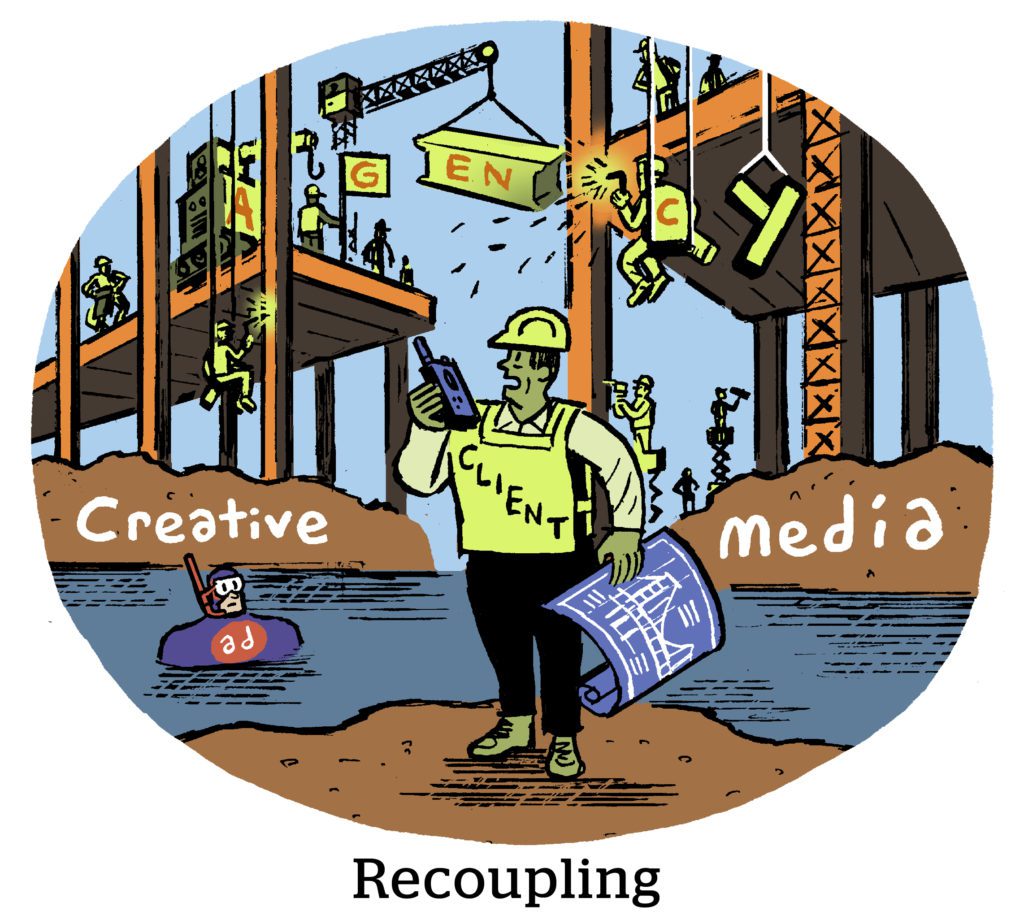
Although thought leaders love to pontificate about the convergence of media and creative on stage at industry conferences, media and creative teams at most brands operate as if they’re allergic to each other.
Not only are these teams siloed internally, they even work with separate agencies, and the data generated by what should be complementary endeavors remains separate.
Until several years ago, that was the case at Bayer, which manufactures well-known over-the-counter drugs, including aspirin, Alka-Seltzer and anti-allergy medication Claritin.
“We had a traditional integrated marketing approach,” said Deniz Can, head of media and creative at Bayer. “Creative ideation was being done by our creative agencies, and then media activation was being planned afterwards.”

No magic pill
But siloed data is only one part of the problem. Off-the-shelf reporting dashboards don’t talk to each other either.
There might be one reporting dash for performance data and a completely separate system for brand lift studies, which makes it hard to understand the relationship between media channel, creative and audience.
Did a piece of ad creative perform well or fail because of the quality of the content itself or because of where the media ran and when? Did it matter what colors the ad used or where the call-to-action button appeared, and did those results differ by audience?
Running that type of analysis for a single A/B test is difficult, let alone trying to compare performance across brands, multiple product categories and different regional markets.
It’s enough to give you a headache. (Or agita.)
Brand managers need a tool “that’s more like a one-stop shop so you can see all of the variables that drive success or failure,” said Emre Acikel, Bayer’s global head of data-driven marketing.
But when Bayer looked, there wasn’t technology on the market that fit its purposes. Bayer wanted a reporting tool that could combine sophisticated media reporting across channels for all campaigns along with creative-level performance information by audience, Acikel said.
And so, around two years ago, Bayer decided to build its own.
Oh, what a relief it is
Bayer partnered with its data agency, fifty-five, to develop a custom in-house creative analytics dashboard built on Google Cloud to more effectively measure and evaluate creative performance.
The dashboard provides Bayer’s media and creative teams with insights into the interplay between creative, media environment and audience segments. Bayer can use this information for planning and optimization across markets, which is a money saver.
 Producing ad creative at scale can be expensive, but if a piece of ad creative performs well against a specific audience target, Bayer can recycle it for similar audiences in different markets while also accounting for cultural nuances.
“One of the big hurdles for precision marketing is actually having enough creative that fits your audiences,” Can said.
For example, for a recent campaign to increase awareness of Bayer Aspirin among Gen Z audiences in Eastern Europe, the brand analyzed reams of past creative data to determine which aspects resonated best with younger demographics and used those themes to feed its creative ideation process. Most of the creative focused on feeling better faster so you can hang out with friends.
CPMs for the campaign, which ran on TikTok, YouTube and Meta across Poland, Romania, Bulgaria, Hungary and Czech Republic, were 30% more efficient than on average. The message reached 12 million people and the creative had a more than 50% view-through rate across markets.
Good medicine
But despite the potential, embedding creative analytics into Bayer’s campaign planning process has been a process of its own.
“The technology aside, adoption is the hardest part,” said Robin Clayton, managing director at fifty-five. “You need to get all of the teams and partners on the same page, and that’s not easy to do, especially at a global level.”
Because it doesn’t matter how cool a reporting tool is if it doesn’t become part of the regular workflow. People often have a tendency to say, “Oh, cool” when they’re introduced to something new, maybe try it for a little while and then revert back to the status quo, Acikel said.
So, rather than giving people access to the new dashboard and leaving them to their own devices, Acikel and Can created internal momentum by distributing insights they generated themselves through the platform.
“All of a sudden people started asking us, ‘How did you come to these conclusions?’ They were excited,” Acikel said. “And that’s when we pointed them in the direction of the tool.”
 A healthy plan
The goal now is to make the data even more widely available across Bayer’s agencies and tech partners so it becomes part of every conversation and meeting about planning and optimization.
“This data is an enabler for us to make more informed decisions,” Can said. “That’s what can happen when data is democratized.”
But distributing data to multiple teams and brands throughout a multinational company doesn’t just “happen.” It has to be an organizational priority.
Can’s own recent title change is a nod to Bayer’s ongoing investment in data-driven creative.
When she joined Bayer in 2020, her job title was “global digital creative and content director.” Early last year, she was promoted to “head of media and creative,” which isn’t a commonly held position at brands.
“Taking an integrated approach to media and creative is a very big focus for us right now,” Can said. “The more we bring these workstreams together, the better the results.”