

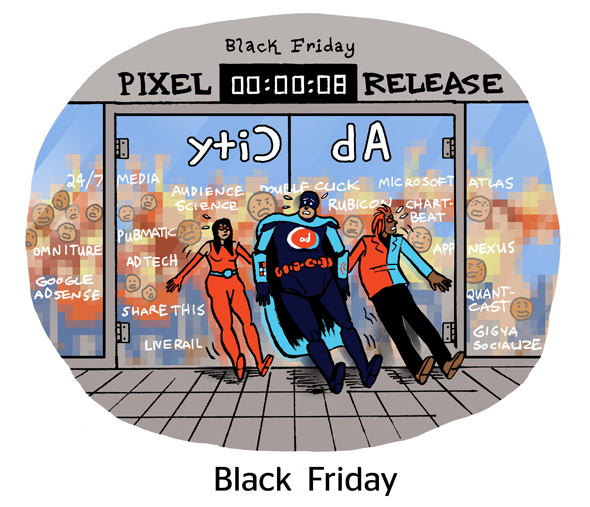
Hey readers, welcome to the AdExchanger Commerce newsletter.
This week, we examine the three big holiday shopping trends this year: markdowns, huge discounts and major sales deals.
See what I did there?
Seriously, though, many forces are driving down prices this holiday season, and this pricing pressure will have major consequences for ecommerce advertisers.
Macro-gloom
Take Target.
Although its stock surged Wednesday based on profit-margin improvements, the retailer set a very low bar for holiday sales, citing low discretionary spend for consumers, who aren’t buying as much electronics, furniture, home goods and clothes.
And don’t forget that The Trade Desk stock briefly tanked last week after it reported earnings and likewise warned investors of a pullback in ad spend this season, citing auto, media and consumer electronics as categories where advertisers are tightening their belts in Q4. Since TTD represents most of the world’s largest advertisers, it sees early indicators when certain verticals are in a slump, CEO Jeff Green told investors.
To be fair, what’s bad for some (namely, advertising companies) isn’t necessarily bad for everyone.
Consumers will pay less for goods this year. And some companies win during recessions.
Amazon and Walmart tend to benefit from lower consumer spending because they catch shoppers looking for the lowest prices.
The platform push
Hence the pressure that ad platforms are putting on advertisers to hype deals this holiday season.
Google, for instance, is introducing new shopping search results with simply massive green labels attached to discounted products.
Walmart is doing the same. A recent search for holiday pantry items on Walmart.com returned a row of organic-ish placements that aren’t sponsored placements (i.e., ads) but did earn that top spot due to discounted prices displayed in a bold green format. The second row is all sponsored placements. The third row finds the first organic placement without a special discount (big ups to Ocean Spray cranberry sauce).
Meta, meanwhile, quietly resumed a 20% discount for North American users making an in-app purchase for the first time – shortly after TikTok started offering 40% discounts for first-time in-app purchases.
But more than any other platform, Amazon treats price and ad spend as two sides of one coin. Amazon only cares about driving the sale, and offering a discount can increase sales more than advertising – potentially with a better profit margin, despite the price cut.
Amazon’s ranking system, therefore, is more sensitive to quality products at a discount than to a brand with high ad bids.
And this year, the Amazon algo seems to be favoring discounts more than ever.
Simple Modern, which makes drinkware and is an Amazon brand that’s now carried in Target, began offering cart value-based discounts last year, said Bryan Porter, the company’s co-founder and chief ecommerce officer, speaking during a recent webinar.
Rather than offering a net 30% off one item, shoppers fill a cart to $75, say, to get a $25 discount. The price efficiencies to ship multiple items together, combined with decreased ad spend (remember, the Amazon algo wants discounts more than ad revenue) means Simple Modern’s margins on the sales remain the same, despite the discount.
 The net effect
In short, platforms that are already pay-to-play media are forcing discounts on brands.
Simple Modern and other brands can find creative ways to discount and retain margin, but it’s getting harder.
Google, for instance, has a new search page tab this season showing only discounted products. It has a Chrome tool, too, that prompts users to a discount shopping page. But sometimes the right product isn’t on sale – even if it’s the better fit or doesn’t cost more.
Some brands don’t run major discounts. Instead, they use the money to offer a relatively low price for most of the year and have higher-quality goods (at least that’s the idea). But Google, Amazon, Walmart and other major shopping hubs are showing more discounts and downranking normal-priced products.
What’s good for Temu – the king of low-priced merchandise – is not good for most product sellers.
Give and take
This year’s discounting bonanza divides marketers. Some run sales all season, while others hold the line until the Thanksgiving weekend.
On the one hand, pushing sales early helps the data-driven ad machine optimize toward likely or potential customers when people start shopping later. Another tactic is to offer early discounts, which Simple Modern’s Porter defends because customers acquired in early November have a higher average lifetime value – they’re actually purchasing because they like the brand, not just as deal-seekers.
“I’m brave enough to admit it,” tweeted Nate Lagos, head of marketing for watch brand Original Grain, about beginning its Black Friday sale on November 1. He touted similar LTV improvements on pre-Black Friday sales, but also said Meta, in particular, needs the time and early customer acquisition data to run effectively when the big shopping surge hits after Thanksgiving.
The flip side is that consumers expect big sales during, well, the Big Sales. If brands offering discounts now have to slash their prices again come Black Friday, their margins will suffer.
Many marketers are anxiously watching a flat line on purchases tied to their November promo sales right now. Their hope is that the Thanksgiving push will show this year despite a gloomy outlook on consumer spending.
“It’s coming. Hang on,” tweeted Taylor Holiday, CEO of ecommerce ad agency Common Thread Collective. “A few more weeks.”









