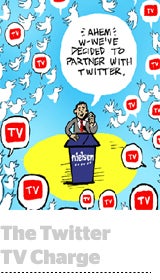
 Panel-based TV ratings and TV-themed “social buzz” are on a collision course, and audience research mainstay Nielsen is doing everything it can to retain its pole position. The company today announced “Nielsen Twitter TV Ratings” to measure TV-related Twitter discussion — both the volume of discussion and its total reach.
Last fall, Nielsen, through a joint venture with McKinsey, NM Incite, acquired real-time social TV service SocialGuide and ushered information on 232-plus US television channels with data on more than 30,000 programs into NM Incite’s software and data solutions. An “exclusive multiyear agreement” between Twitter and Nielsen established a definitive reach metric between the two parties and set the stage for today’s commercial release.
“As advertisers and agencies evaluate what networks and programs they want to put their placements in, they look to television ratings to understand audience size and demographics,” commented Deirdre Bannon, VP of product at SocialGuide and former VP of social media solutions at NM Incite. “That’s the currency today. What we view the Nielsen Twitter TV Ratings as is a complement to that currency. We look at this in conjunction with the data points already being used to make those decisions.”
Nielsen Twitter TV Ratings is not to be confused with Nielsen Brand Effect for Twitter. The Brand Effect product primarily measures the effectiveness of paid advertising on Twitter around sponsored tweets. Conversely, Nielsen Twitter TV Ratings gauges audience reach for television programs based on who’s writing or reading tweets.

“You can bring the full social factor around television programs in and weigh where you want to be based [in terms of] Twitter engagement based on those programs,” Bannon said. “So, these are choices about placement as well as possible willingness to ‘pay.’ If you’re looking at one program vs. another and you layer in the social component on top of other factors, it determines, ‘How does that impact where you want to be and what types of people you’re likely to reach if you make one decision vs. another?’”
Although Nielsen Twitter TV Ratings does not break out demographic and interest graph data just yet, Bannon noted that in Q4 2013 Nielsen will begin to provide information relating to gender around who is seeing and sending tweets around particular programming. Then the psychographics will ultimately follow.
Bannon added, “Even before we release the age and gender demographic information, [the product] by the nature of the data itself is giving a view into the social proclivities of a television audience and their likelihood to amplify messages not just about a television program, but people who are advertising within it.”
Twitter’s facing external competition from Facebook in the race to bridge the increasingly diminishing gap between real-time, trending social conversations and broadcast media. Facebook, which recently introduced hashtags and began attributing social actions like “likes” and “shares” to television programming, announced plans today to expand television data partnerships to 10 broadcasters overseas, according to The Wall Street Journal.
As for who will win the TV-social trending battle, Twitter clearly has a head start. Just days before its S-1 filing, the social platform revealed more details about its Amplify TV reach extension program. “At Nielsen, when we looked at the social TV space, [we saw that] more than 95% of the public social media conversation was happening on Twitter. That’s not to say that Facebook is not big because it certainly is, but it happens by and large behind privacy walls and is not accessible to us as an industry.”
She added, “The platform itself has some characteristics that are very unique to it and the way people engage in the moment that makes it very relatable to live television.”
According to Joel Espelien, a senior analyst with TDG Research, “Twitter provides a real-time measure of engagement with TV shows that is both quantitative (number of Tweets) and qualitative (folks can read the Tweets themselves and see what the fans are saying.)” He noted that the Nielsen Twitter TV ratings “make it clear that Twitter is the unrivaled gold standard for social TV.”