 Google will expand its free marketing measurement software by adding an A/B testing product (Google Optimize), a data reporting and dashboard-creation tool (Google Data Studio) and new machine learning capabilities for Google Analytics.
These products will be available in an open beta starting next month.
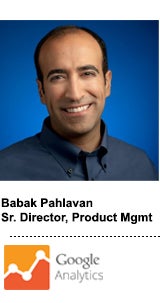
“The ultimate goal is to provide a kind of analyst or analyst support for a company that can’t necessarily afford” market rates on mar tech experts, Babak Pahlavan, senior director of product management at Google’s analytics and measurement group, told AdExchanger. “If you’re a business that’s not truly enterprise, these tools should solve for the majority of problems.”
The tools are modeled on the enterprise attribution suite, as Google Optimize and Google Analytics are self-serve incarnations of the company’s Optimize 360 and Analytics 360 packages.
Pahlavan insists the non-enterprise measurement tools aren’t meant to funnel users of its free, self-serve products to lucrative hands-on services.
“We don’t look at it from a lead-gen perspective,” he said. “It helps us to talk about 360 products if you use Google Analytics, but it’s pretty clear when someone’s an enterprise customer or not.”

Instead, he said, the new products are Google’s early steps toward a business-specific marketing services assistant.
One beta partner that sells precious metals and stones online plugged its first-party data into the new Optimize tool, which identified real collectors compared to one-off shoppers and changed the site experience accordingly.
Adding machine learning to Analytics also lets the system alert site owners of sudden changes – like a sudden change in bounce rates or an underperforming ecom site in a certain region. This piece, however, is still in development.
“We’re still testing and thinking about what passes the threshold for an insight that the business needs to be alerted to,” Pahlavan said.
One issue is communicating the insights quickly. While a company will eventually figure out that its ecommerce platform is having connectivity issues in India, “it’s a matter of compressing that time from days or weeks to minutes or hours.”
Google’s machine learning improves based on how much data it gets from its small and medium-sized business clients.
However, aggregated learnings make their way back to the Google product team, which can help Google’s measurement team identify models that work for certain industry categories and not others or overall best practices in user personalization.
Pahlavan emphasized customer data isn’t shared or cross-pollinated, so each business’s machine learning-driven Google assistant would optimize based only on the data it owns.
“There’s no commingling of data from customer to customer,” Pahlavan said.
Google insisted the tool won’t replace brand marketers without developer skills. “It’s still the human mind that understands the specifics of any business or how best to engage consumers,” Pahlavan said.
But not everyone in the audience during the product launch was convinced. One small-hotel marketer whispered halfway through, “There goes my job.”
But the companies that should really feel threatened come from the expanding ecosystem of measurement firms pitching smaller clients on reasonably priced, close-to-enterprise services.
“We wanted to have a free set of tools that can elevate the industry, which means SMBs and others as well,” Pahlavan said. “At this point you essentially don’t need a mid-tier service.”