

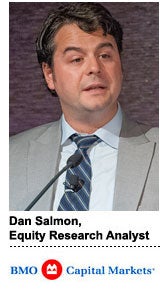
 Dan Salmon is an equity research analyst at BMO Capital Markets and covers advertising and marketing services.
Salmon upgraded Facebook from “Underperform” with a $15 target to “Outperform” and $32 target and explored his outlook in a research note to investors on Monday. You can download it here (PDF).
AdExchanger: Where are the ad dollars that are being poured into Facebook coming from? Other publishers? Is spend moving from TV, yet? And, how do you see this evolving?
DAN SALMON: I don’t think there is one particular bucket to highlight for where the dollars are coming from. I think most every advertiser is re-evaluating what Facebook offers after a flurry of new ad products over the past three to six months. This is particularly the case for their mobile strategies but the question about spend moving from TV is an important one. While the Facebook story around mobile is very well understood by investors, I think we’ll be hearing a lot more in 2013 about how Facebook is helping marketers with more video advertising. The merging of online video and TV advertising budgets has been a big theme that Facebook has been missing out on; that no longer appears to be the case.

What are you hearing about Facebook’s “Custom Audiences” product? What are its broader implications?
I’m hearing great things about Custom Audiences for the most part. I think it’s a great example of how Facebook has listened to the advertising community and created a product that works with their clients’ internal customer marketing databases. As for the broader implications, the fact that advertisers can upload their customers’ mobile phone numbers means it could be increasingly used to target mobile advertising. If there’s one hestitation I’ve heard about Custom Audiences, it’s that some marketers are nervous about handing over a significant cache of first party data, without receiving the same level of detail back from Facebook.
Do you see Facebook’s native monetization efforts (Sponsored Stories) moving into the more programmatic world of Facebook Exchange?
There are two important questions embedded in there. The first is the broader question of native versus programattic for the industry as a whole, and that’s a big challenge. The idea behind native is to create ad formats that are unique to the publisher, while the idea behind programmatic is to scale audience-based buying across multiple publishers. There’s clearly a lot of friction between those two ideas, though I’m keeping an eye out for improvements at creative optimization that aim to tackle that problem. The second element is specific to Facebook and the fact that it offers native ads like Sponsored Stores across a user base of over one billion people. Today Facebook Exchange still only allows DSPs and trading desks to purchase “right rail” graphic display ads. But I don’t see a reason why that couldn’t eventually be extended to News Feed ads like Sponsored Stories. I think Facebook is moving very carefully and deliberatedly with FBX, so we’ll see.
In your new Facebook coverage, you note a risk for Facebook: “a ‘portfolio of social networks’ strategy that is still in its early stages.” What do you mean?
One of the things we’ve always been concerned about with Facebook and any social network is “fashion risk.” This is the idea that as ads enter the platform or early/younger users start to see their parents and aunts and uncles show up on Facebook, it may not be seen as “cool” anymore and then they move to another social network. To minimize the risk of having all of one’s eggs in a single basket, investors are familiar with the idea of portfolio stategy in order to diversify away risk. I wonder if there isn’t a similar idea developing at Facebook. For example, when the company acquired Instagram, many people wondered if its major features would simply be rolled into Facebook. But instead, they are still largely operating as separate platforms, creating a “portfolio of social networks.”
Looking at its array of partnership programs, from Facebook Exchange to the Preferred Marketing Developer Program and “Strategic PMDs,” what do these say to you about the way Facebook wants to partner with the ad ecosystem?
I think the most important thing they say is that Facebook has been doing a lot more outreach to the advertising community in recent months. But it also says that they are testing and learning and sometimes that can cause frustration for partners as policies shift and change. Overall though, I think most people recognize that this is part of the process and want to work with Facebook more, not less.







