

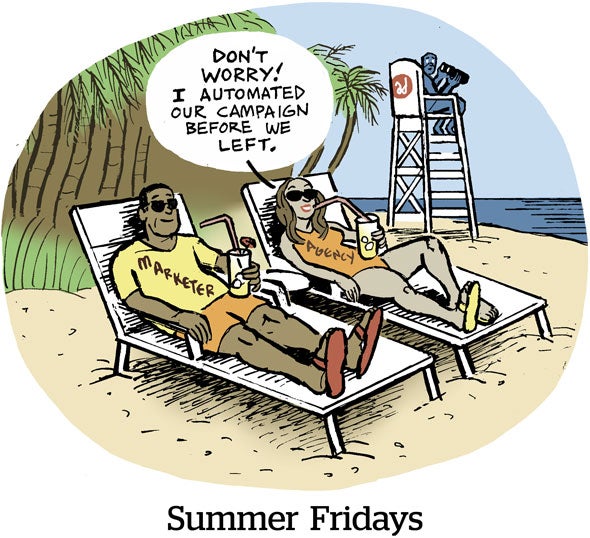
Nexstar Media is the latest addition to a growing list of companies adopting agentic AI for their marketing services.
On Thursday, Nexstar announced that its digital strategy will now use Agentforce for Media, Salesforce’s agentic AI offering for media and entertainment companies.

Nexstar is the first to admit that today’s media landscape is overly fragmented to the point that audience targeting and frequency capping are a whole new type of challenge. Even internally, its sales team has a wide catalog of products across both linear and digital platforms, with different sales processes for certain markets or business verticals, Nexstar CTO Brett Jenkins told AdExchanger.
The hope is that agentic AI tech could bring together those various sales pipelines “into one system,” Jenkins said.
Agent assets
Nexstar’s agentic AI services have two main features that set them apart from human counterparts: automation and pattern recognition.
“We’re very careful about AI replacing humans,” Jenkins said. “Frankly, I don’t believe that is possible,” he said. What AI can do, however, is improve the efficacy of preexisting systems that eat up human time.
Administrative tasks such as compiling data, drafting emails and creating presentations might take hours for a human to complete, he said, but AI can now perform the same tasks much more quickly, freeing up employees’ time for more impactful work, while approving and directing the agentic AI’s output.
AI is also quick to find patterns that are not obvious or even detectable to humans. “The beauty of the machine,” Jenkins said, is that it’s “not understanding what it’s actually looking at; it’s just seeing.” Which is to say, it doesn’t have expectations or biases; it simply observes information and finds the best way to organize it.
Nexstar often uses contextual targeting, especially on news platforms. Insurance ads, for example, tend to be especially effective when placed beside articles that make people think about risk, Jenkins said. Sometimes that’s a straightforward topic, like a car accident.
But the connection between the content and the notion of risk isn’t always front and center, he said. The AI agent can identify an article that falls into the “risk” category when a human wouldn’t necessarily clock it as such.
All eyes ahead
After the agentic AI product identifies the best contextual articles for an ad, it can execute the media plan and optimize on the fly, Jenkins said. The AI also generates pitches on Nexstar’s behalf, he said, based on the results of past campaigns that it oversaw (or is currently overseeing).
Once a campaign launches, AI tracks its success and suggests improvements. At some point, it will be able to go beyond suggesting and actually implement updates independently.
“I think we are not that far,” Jenkins said, from having AI agents “manage full campaigns and curate an entire campaign execution.”
He also noted that while, right now, the agents engage with humans on the back end, soon they’ll engage directly with AI agents that represent the buy side.
When asked whether AI agents function as better salespeople than humans do, Jenkins demurred.
“I think most people still want to talk with people,” he said, “at this stage of the game.”








