

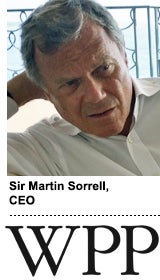
 “There are three big issues: technological disruption, zero-based budgeting (ZBB) and activist investors,” WPP CEO Sir Martin Sorrell told AdExchanger at the Cannes Lions festival.
“The first involves continuous experimentation,” he said, and WPP has certainly walked the talk on that front. Under Sorrell’s leadership, the company has invested in tech far more aggressively than its rivals, spending well over $1 billion on ad tech alone over the years. Most recently, it invested in Celtra alongside key client Unilever.
This interview kicks off on the topic of competitor Publicis Groupe’s decision to pull out of Cannes next year.
AdExchanger: Today, you said a boycott of Cannes isn’t the answer, but its high cost, broad focus and location need to change. Do you expect these things to happen by next year?
The boycott disenfranchises the creative and client community. Clients like winning awards. They like to receive applause from their peers. It’s like the Oscars or the Super Bowl. All I’m saying is, I don’t think it’s going to work.
If clients are using ZBB, let’s use it for Cannes. Starting from scratch, would we do it in Cannes in the middle of June? We would come up with something different.
You said the focus has been lost.

On the work. And how much time have you spent at the Palais looking at the work?
About 10 minutes.
And me as well.
What factors drive your investments?
The quality of the idea, the people and, to some extent, financials. It’s not so much [about] operating profit and margin. You’re looking for the idea and whether it resonates, whether there’s stickiness to it and how good the people are. We make multiple investments [because] we can’t figure out who will win.
How do you deliver on shareholder expectations while clients are cutting budgets?
Clients aren’t cutting budgets. There are growth areas geographically, like India, Colombia, Mexico or Egypt. Digital continues to grow at a high rate.
But there is a parallel universe. For CPG companies, top-line growth is coming down, and there’s focus on cost. Internet companies, which often don’t have profitability or cash flow, usually have something on the top line that justifies the proposition.
Can agencies within a holding company innovate when clients aren’t paying for it?
We try to experiment. It might be more difficult to innovate [our traditional and digital businesses] because clients don’t pay for it. [But] about a third of [our $3 billion in cash flow] goes to acquisitions, a third to buybacks and a third to dividends. We’ve allocated in acquisitions and investments about $700 million each year.
What about letting the agencies you already have within your holding company experiment?
“Holding company” is a derogatory term because it implies holding rather than doing.
What term do you prefer?
Parent companies, or advertising and marketing services companies.
Is your recent consolidation of agency brands within GroupM a response to the commoditization of media buying?
Consolidating two agencies doesn’t mean media buying is a commodity. It means the two agencies are sub-scale. Now [GroupM has] three agencies, which are all $1 billion plus. Digital is even less commoditized because the platform [or] app can vary enormously.
There are clients who believe that media buying is like buying sugar or strawberries. I think people will suffer if they believe that.
We’ve heard a lot of people this week saying media buying is a commodity.
Maybe that’s a lack of depth in the procurement process. Procurement can make a judgment about value on June the 23rd, but next year on June 23rd, everything has moved.
Is the scale you have as useful in digital as it is in print or on TV?
If we’re buying $75 billion [of media] and the largest client in the world is buying $6.5 billion, would scale give you advantage? It should. In a fragmented marketplace like digital, it should be even more.
The attitude toward opt-in transparency is totally illogical. If Xaxis can buy inventory 30% cheaper because of aggregation, that will be successful. Two clients switched their position from a total negativism about programmatic to [welcoming] it, because it helps meet their business requirements.
It’s also a high-margin business.
That’s exaggerated as well. You’re reading too literally in to the Association of National Advertisers’ report.
There is still that pressure on margins.
The pressure is self-induced by agencies. There’s a lot of discounting being done by agencies, who don’t have control over pricing. They’re making promises about things they don’t control.
There’s a dog fight, a race to the bottom. Payment terms, intellectual property protection, media rates, guarantees – when you talk about commoditization, that’s what you’re talking about.
Media buying is the biggest item on client P&Ls, which is why procurement focuses on it. Clients often say, “You’re my biggest supplier.” But they’re looking at the media cost, which is a pass-through. Procurement looks at that and says, “Let’s control the pass-through,” but the agency doesn’t have control over that. It puts pressure on the agency.
What will WPP look like five years out, and will you be there to see it?
If they still want me, yes. It’ll be more horizontal, more unified. You’ll see Ogilvy, Kantar, WPP Health and Wellness and GroupM consolidating. It will [enter] fast-growth markets because that’s where the next $1 billion will come from. It will be more digital and data-driven.
In five years’ time, I don’t think there will be six holding companies.
Who is out?
I would see IPG, Havas and Dentsu maybe having done something.
Will there be a repeat of the Omnicom-Publicis merger?
That wasn’t unintelligent. It failed because the two people running it couldn’t agree on the structure. Which begs the question: If it was such a good idea, which I think it was, why didn’t it happen anyways? They should kick the two out and someone else should do it. [Publcis Groupe CEO] Arthur Sadoun and [Worldwide BBDO CEO] Andrew Robertson should’ve put it together.
Ryan Joe contributed. Edited for clarity.







