 A change has happened among creative agencies in which they’re now using cloud-based solutions to develop their in-house creative ideas.
Part of this has to do with the changing demands of business clients and the growing acceptance of crowdsourced content for marketing purposes.
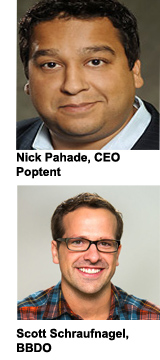
“Agencies are now being tasked with delivering high-quality content at a price that’s relevant for 2014 in a world where the average shelf life of a video is now less than two weeks,” said Nick Pahade, CEO of social video marketing platform Poptent. This imperative alters the brainstorming process and time frame behind creative briefs. Pahade spent the majority of his career on the agency side, most recently as North American CEO for IPG Mediabrands’ Initiative.
This shift has been gradually developing. Ten years ago, crowdsourced and consumer-generated creative content started to take off and, soon after, viral YouTube video stars became viable threats to brand-approved and agency-created content. Only now are agencies beginning to embrace this change.
“I think, on a macro level, you see a fear of these crowdsourced models [and now, the same could be said about marketing tech and SaaS] but the way we look at it from an agency perspective is, as an industry, you have to evolve,” said Scott Schraufnagel, an account lead for advertising agency BBDO Proximity Minneapolis, which works with a number of brands ranging from Hormel to Schwan’s. “Twenty years ago, it was the same thing [when talk focused on what the] Internet would do to TV.”

For creative agencies, one of the challenges is how much weight should be put toward earned media campaigns vs. the paid resources that often amplify them. Then there’s the need to balance the spontaneity that crowdsourced content brings with actual process of creating such content. This was one of the biggest challenges when BBDO Proximity helped create the International Bacon Film Festival in New York on behalf of Hormel Black Label Bacon.
“In all honesty, we’ve tried to do user-generated videos about bacon in the past,” Schraufnagel said. “But what you find, typically, is it’s good in theory but [not] when it comes to execution.”
BBDO Proximity used the Poptent platform to source 70 qualified filmmakers and 200 video content submissions. The platform is designed to give brands and agencies access to 70,000 amateur and professional videographers around the globe through a Video Assignments portal, as well as additional functionality like distribution, targeting and reporting and measurement.
“It wasn’t a send-out-the-brief and wait eight weeks and you hope you get something,” Schraufnagel added. “You can really monitor it from a people standpoint, instead of just tools, and actually ask filmmakers, ‘Hey, is showing product a requirement? Are you set on X?’”
Hormel used Poptent’s platform to power its filmmaker casting call for the bacon festival, which took place in October, and where Hormel awarded $11,000 to the individual with the best bacon-themed film. Alongside the film festival promotion, BBDO Proximity ran a series of supporting digital advertisements through native-ads platform Sharethrough. All of the ads linked to the brand YouTube channel and BBDO was able to deliver additional branded messaging through native placements.
“If we were to actually make the films ourselves, it would have lost some of the appeal because these were actual amateur and professional filmmakers striving to actually win something, which gives you that authenticity,” Schraufnagel said. “I think that’s where [SaaS] platforms like Poptent can be a tool in your belt as an agency to tell a more compelling story.”
Although Poptent helps automate content production and creative sourcing, “obviously programmatic video is an extremely hot area,” Pahade noted. “You can slice and dice and enable content [to be bought] programmatically, but in terms of the actual content creation side of it … it’s still untapped.”