

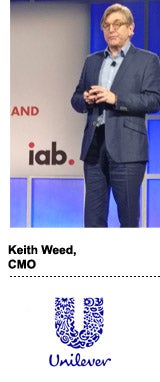
In an early draft of his prepared remarks at the IAB Annual Leadership Meeting on Monday, Unilever CMO Keith Weed threatened to stop advertising on digital platforms that “do not make a positive contribution to society.”
But when he actually took the stage in Palm Desert, Calif., a few hours later, Weed struck a softer tone. Rather than issue an ultimatum, he urged brands to work with digital platforms to ensure messaging happens in a “brand-suitable” environment.
The CPG giant also issued three commitments in a press release: It will not invest in platforms that propagate divisive or hate-filled content, it will avoid gender stereotypes in advertising and it will only work with organizations that help improve digital infrastructure, like building a single measurement system or improving the customer experience “from targeting to delivery.”
Despite P&G Chief Brand Officer Marc Pritchard’s criticism last year about the ad industry’s supply chain issues, Weed this year said those issues are primarily brand concerns that consumers don’t care about as much as fake news and Russians influencing elections.
“We’re no longer talking about making the digital supply chain more efficient,” he explained. “We’re talking about how it impacts society. There’s an underlying issue of trust and truth going on.”

Of course, brands aren’t motivated solely by altruism when they proclaim their commitment to social responsibility. There is a very clear business motivation.
Big brands like Unilever are buffeted by startups that manufacture competing products and, more importantly, have direct relationships with consumers. Unilever is certainly aware of these challengers – it even bought Dollar Shave Club in 2016.
And the direct relationships held by companies like Dollar Shave Club drive first-party data, which can be used to further cultivate consumer relationships and drive sales.
“With no trust, there’s no data, and with no data, there’s no brand and no company,” Weed said. Later he added, “A brand without trust is just a product.”
So it’s important for Unilever to associate its brands with content that isn’t just “brand-safe” in the conventional sense; it wants to associate brands alongside content that can be trusted.
Despite the ultimatum-like wording in Unilever’s press release, Weed took a softer tack on stage. Instead of threatening to withdraw advertising from digital platforms that didn’t adhere to Unilever’s “brand suitability” initiatives, he advocated that brands work with those platforms to improve.
For instance, he said Unilever never withdrew from YouTube during its big brand safety scare last year. “It’s too easy to bash tech companies and tell them to sort things out,” Weed said.
In continuing to work with YouTube, he claimed, Unilever had more productive conversations with the video platforms than the companies that reflexively pulled spend. Likewise, Weed advocated continuing to work with Facebook as it reconfigures its algorithm to prioritize updates from family and friends.
“This is the right thing to do,” he said. “Put consumer experience in the core of these platforms. Let’s work with Facebook to help them get to the platform they want it to be and we want it to be.”








