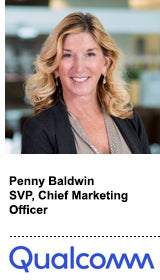
Qualcomm CMO Penny Baldwin has the unique challenge of marketing a behind-the-scenes brand.
While Qualcomm technology powers smart phones with wireless cellular technology, video streaming and mobile GPS, most people outside of the technology world may not even realize it exists.
“Qualcomm has been somewhat of a silent, invisible brand in the background,” Baldwin said.
Qualcomm, one of the key enablers of 5G technology, is trying to position itself around the future of cellular technology and open its brand up to working with new industries.
It now needs to reach a new audience of IoT device makers, driverless car manufacturers and smart city planners – new industries that incorporate 5G technology.
“5G promises to be more transformative than any previous cellular transition,” Baldwin said. “We’re going to have to shift our business model and marketing capacity to accommodate that world.”
But Qualcomm’s messaging has been disrupted frequently over the last year. In 2018, President Trump blocked an attempted takeover from Singapore-based company Broadcom. And Qualcomm made recent headlines when it lost an antitrust case brought by the FTC.
Baldwin spoke with AdExchanger.

AdExchanger: How do events like these disrupt your marketing strategy?
PENNY BALDWIN: We’ve been through quite the interesting set of experiences in the course of the last year and a half. You really have to manage all of the train tracks.
Typically, we’ve anticipated and prepared for all manner of possibility. We’re proactive in terms of anticipating possible occurrences, and when they do take place we’re ready. But we also have to keep the core business moving ahead. We’re a publicly held company, we’re accountable to our shareholders and we need to make sure that our marketing initiatives don’t fall off the train tracks.
Right now, those tracks lead to 5G. How will it change Qualcomm’s marketing strategy?
We’re porting our mobile technologies to new applications. We have to appeal to the business leaders and technology professionals who design those systems and capabilities to use Qualcomm.
For example, we’re talking to companies right now building stadiums from scratch who are anxious to use 5G connectivity. The No. 1 benefit to consumers when they’re in these venues is that they’re able to share their experiences and communicate on premise. But given the network constraints, that often gets blocked. With 5G, network capacity increases 100X. If you have a 5G stadium with 75,000 people, all of them can start streaming 4k video immediately.
How will you apply the benefits of 5G to your own marketing initiatives?
I am pushing hard on the use of these emerging applications in our own marketing. How can we harness the power of AI to make our own marketing initiatives more intelligent? When 5G becomes more pervasive, how can we use AR, VR and XR experiences in our marketing to showcase our own technology?
What changes have you made to Qualcomm’s marketing strategy since joining as CMO a year and a half ago?
We’ve completely rearchitected the marketing mix to allow for longer form content. People have a profound lack of understanding of what we do. We need to tell that story in a much more effective way as opposed to slapping our logo on things. In the absence of understanding what you do, that high-level brand awareness is vacuous.
We’ve rearchitected the team and added new capabilities, such as a new role in strategy and analytics. The goal is to drive one marketing plan so we’re aligned worldwide. Analytics capabilities will make sure we hold our teams accountable to meeting business metrics.
We’re also pushing hard on brand attribution. We built in conditions in our agreements with handset manufacturers to make sure our launches are co-branded. When you see 5G phone launches around the world, you’ll see a lot more brand attribution for Qualcomm.
How have you rearchitected your media mix?
The mainstay of the media mix is digital, print, social, advocacy and influencer marketing. It’s always helpful to have other credible sources evangelize on your behalf.
We use a lot of social media platforms and content partnerships with leading publications like Axios and The Wall Street Journal. And we engage in events on a regular basis, like Mobile World Congress in Barcelona, and soon in Shanghai.
How will your audience strategy shift as more industries leverage 5G?
The handset manufacturing business is a highly defined universe that we communicate with personally. We can identify the people we need to get to and talk to them personally. But Industrial IoT, for example, is a more fragmented and larger customer universe.
A good example is today, our websites are distributed. But the customer experience of searching for information and buying our products is a bit difficult. So we’re getting to one digital experience that is much more streamlined based on key website principals that people expect today. It’s easy to find the information you want and entirely linked so you don’t have to travel to different sites.
This interview has been edited and condensed.