

Intel’s decision to bring programmatic media buying in-house boiled down to this: audience insights.
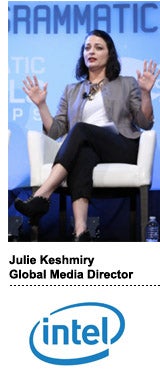
“Our biggest aha, our epiphany, was that we wanted to have a holistic view of our customer,” Julie Keshmiry, Intel’s global media director, said Tuesday at Programmatic I/O in San Francisco.
But getting that view is particularly difficult for a non-customer-facing brand like Intel, whose products, whether that be chips for laptops or microprocessors for autonomous vehicles, are components of other solutions. They’re sold in the B2B setting and through OEMs such as Lenovo or Apple.
For that reason, Intel doesn’t have transactional data to mine in the way that many brands do. So, the data signal coming back from programmatic is where Intel can really learn about its audience – and Intel felt compelled to take that ownership.
Bringing media buying in-house, however, didn’t mean a severing of Intel’s agency relationships. The brand, which turned to programmatic consulting firm Unbound to help jumpstart its in-house transition, still works closely with its agency partners on strategy and planning.
But from a data perspective, it made the most sense for Intel to bring its ad stack in-house and maintain direct contracts with everyone from demand-side platforms (DSPs) to ad-serving and third-party verification tools like Integral Ad Science.

“We have a great relationship with our agency,” Keshmiry said. “But we ultimately felt that we couldn’t outsource knowledge of our audience to the agency. We need to be the ones who know the most about our audience.”
Once it decided to go fully hands-on-keyboards, Intel needed to go out and actually find those hands (attached to people), and that was, and continues to be, no easy task. Quite a few jobs needed filling across a variety of functions, including technology and integrations, overall strategy and analytics.
But the ad tech talent pool is small and still maturing, Keshmiry said. Intel “underestimated how long it would take” to find the right people.
It’s not just about hiring or training, though. Brands considering an in-house transition also need to think about where to integrate these roles internally, whether it’s within the IT department, marketing or another team altogether. At Intel, marketing handles the advertising stack, but the team works closely with IT.
“There’s a weird stereotype that marketing and IT are like oil and water, they never get along,” Keshmiry said. “But our teams have great partnerships, and that’s important. Because when you want that holistic view of the customer, there’s a lot of back-end integration that needs to happen.”
The most productive part of Intel’s ongoing in-house journey, which began around a year and a half ago, is that “it forces you to take an audience-first approach, even if the organization is not set up that way.”
Now that Intel has its sea legs, it’s realizing that programmatic, a bit like an Intel chip, is a component of something larger: an overall data-driven strategy.
Intel has put in the man hours and reached the point where it can do things like extract CRM data from Salesforce, put it into a data management platform and use it to buy segments in a DSP. The foundation is there.
But it’s still a work in progress, Keshmiry said, and the question remains: “What provides the best insights?”







