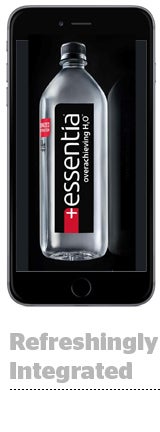
Bottled water brand Essentia Water is getting its feet wet with digital marketing.
“Our number-one goal is to bring our brand messaging to life across digital platforms, regardless of the channel,” said Zola Kane, Essentia Water’s senior director of digital marketing.
Essentia, purveyor of what it calls ionized alkaline water, launched an integrated brand campaign in mid-May to position itself as an aspirational brand for active millennials.
“Our core targets are 18-to-34-year-olds, but we’re also thinking about targeting based on mindset, things like lifestyle, passions, interests and behaviors,” she said. “That means finding the intersection between who these folks are and what they’re doing online.”
Essentia is also getting more strategic about its paid digital activities with help from indie shop Periscope, which became the brand’s agency of record in March.
“We work very closely with our agency from a planning, executing and buying standpoint,” Kane said. “Over the last couple of years, digital has become foundational to everything we do, because the people we’re looking to reach are true digital natives.”
AdExchanger caught up with Kane as well as Karyn Abrahamson, Essentia’s VP of marketing and brand innovation and a Microsoft, Starbucks and T-Mobile marketing vet, to talk programmatic, data and how not to get caught up in analysis paralysis.

 AdExchanger: Do you have any direct relationships with tech partners or platforms?
ZOLA KANE: We rely on our agency, Periscope, to manage the relationships with our various media partners, whether it’s ad networks or direct deals. But I always appreciate being in touch with our partners. It’s important that marketers are always involved in the conversation and that we stay updated on innovations and new features.
How would you describe Essentia’s digital strategy?
ZK: Our mix includes platforms to help drive brand awareness and others to make sure that we’re pulling people into the funnel and moving them down through consideration and purchase intent.
From a content standpoint, we tell stories online of extraordinary people doing extraordinary things to highlight the spirit or mindset of overachieving, with a message that explains how our water can help them.
How do you find your overachievers, and how do you think about targeting them?
KARYN ABRAHAMSON: We’re targeting millennials because they index the highest for premium bottled water consumption. But we’re also going deeper to find the things that are important to them and looking at their mentality.
ZK: Our strategy is audience-based. We work with hundreds of online channels through ad networks, based on a combination of our target’s interests and passion intersected with their behavior online. You’ll see our messages coming up on Men’s Health, GQ, InStyle or a site dedicated to running.
This summer, you’ll also see us on Spotify and Pandora. We know music is very important to our audience and that it’s our responsibility to be multiscreen or, more accurately, screen agnostic. They’re out there living their life. And regardless of whether it’s through mobile, offline or otherwise, we want to reach them in the same way.
Do you buy programmatically?
ZK: Programmatic is really important to us, and we approach it with performance in mind. We’re constantly evaluating performance against our goals and objectives and optimizing to ensure we’re driving reach, efficiency and engagement. That is also how we evaluate any tactic or platform we use.
What data is interesting to you, and what do you collect?
ZK: The main data sources we leverage to help us understand our audience are comScore, IRI and Simmons, and from an optimization standpoint, we use Google Analytics, analytics across the social platforms and a social listening tool.
But at the end of the day, even if you have all the data in the world, you need to make sure the data you have can actually inform your strategies. We look for clear action items to come out of the data, rather than allowing ourselves to become inundated with it. The data we collect has to help us move the business forward.
KA: We use data to understand where our consumers shop, to see whether that’s in proximity to where they live. We use data to help us understand media performance and if our media reached our target efficiently. And when we first started working on our brand strategy, we spent about six months doing a deep dive into the premium water category, to see what our competitors were doing, and running focus groups.
But we don’t get into analysis paralysis. I’ve worked for brands in the past that overanalyzed everything to the point that they couldn’t think creatively anymore because they were mired in the numbers. We’re careful to create a balance between insightful understanding and creativity.