

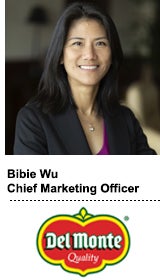
Consumer food preferences are changing almost as quickly as their media habits. For 130-year-old packaged foods brand Del Monte, keeping up with both required a major revamp.
Del Monte used branding marketing campaigns to increase awareness of its canned fruits and vegetables and shopper marketing tactics to drive purchases.
But with consumers gravitating toward fresh, healthy food and away from linear TV and physical retail stores, Del Monte had to rethink both its products and how to get them in front of customers.
“We put an emphasis on products that are convenient and available on-the-go to fit people’s busy lifestyles,” said Bibie Wu, CMO of Del Monte. “Certainly, our media strategies need to adapt to fit that mold. We’re speaking to consumers in the mediums they are interacting with.”
In addition to launching new food items like quinoa quick meals and bubble fruit cups, Del Monte has been spending more on digital channels through online video, display and retail search. The latter is increasingly important as online marketplaces like Amazon and Walmart emerge as major media companies in their own right.
“There’s so much pressure at shelf,” Wu said. “The retailers are giving you less space than before and less time to prove success. The cost of entry can be quite high as you battle it out with different competitors.”

And as for any company that’s been around for over a century, Del Monte has to balance promoting new products in different places with supporting its primary brands.
“You don’t want to leave behind your core business where you have all your volume,” Wu said. “You have to make those choices to balance the investment.”
She spoke with AdExchanger.
AdExchanger: What’s working well for Del Monte as you shift your budget toward digital channels?
BIBIE WU: We’re seeing really good returns from online video. What’s nice about that is production costs are often lower than shooting for TV. That gives us a lot of flexibility to come up with multiple pieces of creative or vary it to our audience. And as opposed to a static display banner, you’re able to tell more of a story.
How has your search budget shifted as more activity flows to retailer sites?
We’re seeing higher ROI with retailer search than we see in general keyword search. That’s definitely an area where we’ve been trying to prioritize.
The nice thing about that is you can leverage that with a retailer. If we’ve got search [activity] pointing to their brick and mortar or online [store], we can show them that we’re driving sales and we’re able to leverage that for better merchandizing or distribution support.
How is the shopper marketing space changing online?
I see shopper marketing as an area of investment. If you do it right in this competitive environment, shopper marketing can not only be a very effective way of reaching the consumer, but also something you can leverage for a mutual benefit with the retailer.
It’s also flexible. Those dollars can flow to where you’re getting distribution. You can divert them from where you didn’t get the distribution you wanted and flow it to the retailers you think are going to make a difference.
Are you funneling more shopper marketing budget to Amazon?
Amazon is in invest mode. They are an important part of the overall sales mix. We are in conversations with them all the time to be on the front end of their agenda.
Like many CPGs, they’re not the biggest channel yet, but they’re certainly one of if not the fastest growing. It’s an area where quite frankly we over invest, because we want to be where the future sales are. We’ve been on many of those platforms as an early partner. Our growth on ecommerce is either at or above industry performance rates. We think we’re going to continue to get strong double-digit growth there.
How are you approaching the TV landscape as linear viewing fragments? Where can you recreate that scale?
We are still in linear TV. We are doing more in terms of streaming because that’s where the consumer is going.
We recently debuted a Del Monte master brand campaign. We’re trying to be efficient and leverage our assets. We’re taking footage we have and we’re adding to that to tell multiple stories about our product line. It will feel very big because it will have the scale of an effective campaign, but also be able to highlight different parts of our portfolio
How is Del Monte approaching marketing in a period of cost cutting for CPGs?
That is a challenge we all face. I believe ideas drive funding. Well more than half of our marketing dollars goes to support innovation because money flows to the best ideas. That is going to be the primary area we invest behind in our marketing going forward.
We’re also committed to brand building. Our marketing investment has gone up steadily over the past few years. When you look at the collective whole we’re investing in our campaign, we’re probably up 25% versus the past years in terms of support.
This interview has been edited and condensed.








