

 Rocket Fuel, one of a growing pack of public ad tech companies, reported 95% growth in revenues and 107% margin acceleration during the first quarter. But it wasn’t enough for Wall Street, which punished the company’s stock after hours – perhaps in light of decelerating top-line revenues.
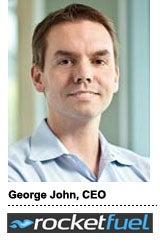
Rocket Fuel’s active customers more than doubled year over year to 1,251, and the company now wants to grow its share of budget with some of its largest advertisers. It has seen some modest success in this area, according to CEO George John.
One advertiser spent $150,000 in March, $250,000 in April, and is on track to spend $350,000 in May. The total investment for the year for this client will clear $1 million in 2014, but John said he is not yet satisfied. “We have a few advertisers above $5 million but none at the $10 million to $20 million we’d like to see,” he said on the company’s earnings call Thursday.
Analysts on the call seemed concerned about whether Rocket Fuel will suffer disintermediation as brands and agencies gain prowess with programmatic buying methods. Or, as one put it on the call, is the company seeing increased competitiveness from agency trading desks like Xaxis (WPP Group), Vivaki AOD (Publicis Groupe), Accuen (Omnicom Group), Affiperf (Havas), Amnet (Dentsu) and Magna Global (Interpublic Group)?
The answer, apparently: Ask again later.
“We’ve seen significant growth in one of the holding companies by coming up with a more win-win approach with their trading desk. We’ll see how it unfolds,” John said, somewhat mysteriously.

Meanwhile, Dan Salmon of BMO Capital Markets approached the same question another way by asking about Rocket Fuel’s plans to ramp up the Software-as-a-Service (SaaS) revenue stream. Management hinted such an option might be on the table for 2015. “There are things we need to do in terms of UI,” said CFO Peter Bardwick. But the company likes the idea of “leveraging the core platform, which is what we’ve done in mobile (and) TV/brand.”
One of Rocket Fuel’s big differentiators is its comprehensive buying from a multitude of supply sources, according to John. It transacts through Adap.tv, Facebook, Google, MoPub, Millennial Media, OpenX, PubMatic, Yahoo, SpotXchange, Tremor Video and others. “We can negotiate favorable terms with these exchanges due to our scale,” John said.
Rocket Fuel’s Q1 gross revenue was $74.4 million, a 95% increase from the year ago period, the company said Thursday. That represents a slowing of top-line revenue growth, as Q4’s revenue increase was 113%. Meanwhile “revenue less media costs,” the more telling metric for any ad network company, increased 107% to $44.7 million. Media margins were 60%.
The powerful revenue growth appeared not to impress Wall Street, as shares of FUEL fell 25% in after-hours trading to an all-time low of $20.59, well below its $29 IPO strike price. Investors have lately soured on digital advertising stocks; Rubicon Project and Criteo have shared a fate similar to Rocket Fuel (and, indeed, many tech stocks) in recent weeks. More on that.







