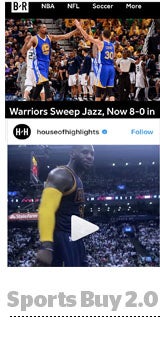
 During Bleacher Report’s flashy NewFront late last week, CEO Dave Finocchio made the following pitch to advertisers: “Use us to maintain your relevancy all year long.”
Millennials, he added, aren’t watching three- to four-hour live sports broadcasts anymore and big tentpole commercials alone won’t cut it.
Whereas previous generations got their news and information from “SportsCenter’s” talking heads, pubs like Bleacher Report and Barstool Sports are betting that millennials get their sports news on mobile in their social feeds.
Traditional broadcasters recognize this trend, too.
Last March, Turner, which backs Bleacher Report, said it would invest an additional $100 million over three years so the sports pub could expand its video production prowess.
As such, Bleacher Report has created new branded, episodic video series such as “Game of Zones,” which aired on social channels during the NBA playoffs.
“We really see young sports fans far more interested in the intersection of sports and culture than ever before,” Rory Brown, the president of Bleacher Report, told AdExchanger. “We’re seeing a change where people are just as interested in what Drake is doing courtside at a basketball game versus what actually happened in the game itself.”

But Bleacher Report is not immune from viewer fragmentation – consider its recent round of layoffs and restructuring.
 Having broadcast TV’s backing only helps here, Brown claims, since Turner’s resources will help it produce more original, social and episodic content from recognizable personalities rather than just aggregating and repackaging sports news.
He added: “Turner has made a lot of smart bets on the rights they do own, particularly the NBA playoffs and March Madness. These are a lot of events that appeal to young people and therefore there is pretty incredible crossover to Bleacher Report’s audience.”
Meanwhile, brands like Anheuser-Busch that still invest a ton in traditional TV, see these vertical sports and lifestyle pubs as incremental opportunities to drive organic engagement beyond their paid spots on game night.
For instance, during March Madness, Anheuser-Busch’s Bud Light did a massive sponsored placement with the satirical sports pub Barstool Sports.
Barstool caters to 21- to 34-year-old males and has a notoriously controversial edge. The NFL, for instance, refused to give Barstool press credentials for the Super Bowl after four Barstool employees staged a sit-in at the league’s New York office in the wake of Deflategate.
Rogue tactics notwithstanding, Bud Light wanted to drive chatter and engagement beyond its paid placements by talking directly to Barstool’s elusive audience.
During March Madness, Bud Light “took over” Barstool’s experiential in-house bar and Facebook Live studio set where Barstool’s bloggers partook in a bracket challenge for an all-expenses-paid trip to Vegas and posted live social updates with the hashtag #budlightbusters.
The brand worked with Barstool to create a custom video series and branded content, distributed on Barstool’s social channels.
As a result, Bud Light earned 126 million social impressions across Twitter and Instagram, reached 421,000 people on Facebook Live and generated more than 20,500 user-generated posts.
 “The biggest surprise to us was the organic conversation that evolved out of the campaign,” according to Nick Kelly, Anheuser-Busch’s director of sports experiential marketing, who manages sports and league sponsorships across its portfolio of beverage brands. “The fans of Barstool almost immediately adopted it, allowing us to directly engage in an authentic conversation.”
And Barstool, like Bleacher Report, has also attracted the interest of traditional broadcasters. It clinched a live video partnership with Comedy Central leading up to the Super Bowl as the pub vied for more video ad dollars.
Similar to Bleacher Report’s operation, TV companies look to their digital partners as the experts in social content creation.
“We’ve gone aggressively into live, on-location and episodic video,” said Erika Nardini, CEO of Barstool Sports. “In a social era, personalities are publishers and a lot of our personalities bring a huge audience. We know how to create content that travels socially.”