
Here’s today’s AdExchanger.com news round-up… Want it by email? Sign up here.
The Lost-Gen Apps
A working paper submitted to the National Bureau of Economic Research this month lays out the mathematical case for a “Lost Generation” of mobile businesses following the implementation of GDPR.
In the year and a half after GDPR went into effect in 2018, the number of apps in European app stores dropped by about a third and the number of new apps to enter the market fell by half. The results were steady across the Google Play Store and Apple App Store.
There are a few extenuating factors. For one, the data is parsed from commercial vendors and from Google Play, and some new apps aren’t picked up the same quarter they launch. There was also no control group.
But EU app store numbers were growing fast through 2017, before plummeting over the course of 2018. The number of new apps to reach 100,000 installs was down 40%.
Then again, GDPR wasn’t written to foster a stronger market, as antitrust laws are. It’s a privacy law. So the effect of unrealized business value may not have been factored in at all, regardless of fancy regression analyses.
“Whatever the privacy benefits of GDPR, they come at substantial costs in foregone innovation,” according to the authors.

Double-Data
Marketers are always looking for the single-best solution. It’s a never-ending hunt for the best of breed.
“But most of the time, we’re not dealing with a zero-sum game,” writes U of Digital Founder Shiv Gupta at VentureBeat.
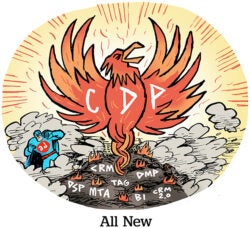
Marketers weighing the pros and cons of consumer data platforms (CDPs) versus data management platforms (DMPs), for instance, sometimes miss the fact that, just like in the TV measurement race, there’s power in numbers when it comes to filling data gaps.
CDPs hold first-party data and follow individuals over time. DMPs, on the other hand, use more aggregate and third-party data for media and audience modeling.
CDP data is granular but not very scalable. Publishers that rely solely on authenticated users (i.e., log-ins) could be missing as much as 80% of their audience.
But DMPs can integrate with CDPs to parcel individuals into audience segments. And, conversely, CDPs can be integrated to enrich DMP audience profiles by layering in first-party customer data.
“Just imagine LeBron James and Steph Curry on the same team,” Gupta writes. Marketers can learn from the NBA, he says, where it now takes multiple star contributors to make a winning team, not just one key player.
Throw The Kitchen Sync At It
Has your campaign performance recently dropped for Facebook, Instagram or whatever Meta-owned app you pour money into?
Well, two weeks ago, the company began treating opt-out requests on one app as an explicit opt-out across all synced accounts. That’s the explanation given by a Meta rep to Jason Portnoy, a paid media advisor, who shared a tweet about it. The rep also mentions an upcoming “Data from Partners” control to launch later this year. That sounds similar to an existing Instagram feature, except Instagram currently restricts data to third parties, not sister apps.
But there’s no guarantee that the recent performance drop-off stems from synced opt-outs. While synced opt-outs hurt – especially for marketers with centralized Facebook and Instagram campaigns – it’s hard to pin down a reason for performance issues when the Meta ad platform has been a bug-ridden mess all year.
Some days, ad buyers awake to find budgets emptied overnight, having served ads in the wee hours of the morning. Sometimes campaigns are halted with no warning, seemingly at random.
Meta was up front with ad buyers that campaign performance would be a cluster this year thanks to Apple’s privacy changes and signal loss in general. And it certainly has been.
Advertisers understand that Facebook and Instagram require some post-iOS 14.5 tinkering. But their patience wears thin when that tinkering is with their money.
But Wait, There’s More!
Inside Elon Musk’s big plans for Twitter. (TL;DR: The idea is for ad revenue to drop from 90% to 45% of overall revenue, which will be made up for mostly by more subscriptions.) [NYT]
How Netflix’s stumbles are causing rivals to rethink the streaming business. [Los Angeles Times]
The SaaS pandemic success story is ending in SaaS sell-offs. [TechCrunch]
How Omnicom Media Group is making sense of clean room complexities. [Digiday]
You’re Hired!
TripAdvisor names Trade Desk vet Matt Goldberg as its new CEO, taking over from the founder. [Adweek]
Sony Music Entertainment bolsters its global podcast division with new ad sales leadership hires. [release]
Paul Teddy joins search agency GR0 as SEO director. [release]








