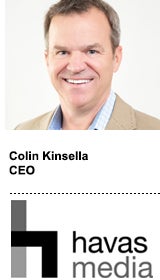
The digital and programmatic space needs a refresh because clients are getting burned and returning to more traditional media principals, according to Colin Kinsella, Havas Media’s North American CEO.
“A lot of buyers want to get back into TV, radio, out-of-home and print because they feel like digital can get lost,” he said. “The most accountable media turned into the least accountable media and the most filled with fraud.”
Kinsella started his digital media career at Razorfish, where he was promoted to chief investment officer, before becoming CEO of Digitas in 2011. He was CEO of Mindshare before taking the helm at Havas Media in 2016.
Today, as the cost of marketing and data increases, what brands need most is efficiency and precision, regardless of all the market’s shiny tools, he said.
“How do you be smart, efficient and get your brand in front of the right target in a way that doesn’t necessitate an extreme amount of content or creative?” he said.
That back-to-basics mentality seems to be working for Havas Media, which has grown 30% in the past two years in a tough environment for agencies. Many agencies struggle to attract and retain talent, but turnover declined at Havas from 40% to 20% over the same period.
Kinsella spoke with AdExchanger.

AdExchanger: What’s your biggest concern as CEO of a media agency?
COLIN KINSELLA: How much more is it costing a client to get a message into the marketplace?
It used to be the 80/20 rule. Now, with the cost of media, data, content, technology and production, [more than half] of client dollars are not going toward media. How do you get rid of the ad-tech tax? And is the ad-tech tax just a clever way of saying the ecosystem has gotten more expensive? What do we do to bring that back?
There’s a lot of expense going into data. There is so much data in the marketplace and so many different firms that they all start to overlap. More data doesn’t mean better.
Where are people overspending on data?
Clients are changing their data sets every year. They’re not getting any longevity in leveraging the data they have. They keep purchasing more in search of some holy grail. When you have too much data, you have data that competes against other pieces of data, so it’s hard to know what’s right. A thousand-piece puzzle is really hard to stitch together.
How does Havas Media navigate the data marketplace?
As an agency, you have to be proficient at all different variants, but you also have to be very clear. We have a lot of discussions about making sure that there aren’t too many inputs because if you open the aperture on inputs, it’s very difficult to get to a closed aperture on impact.
Speaking of data, what synergies exist with your parent, Vivendi?
Vivendi is very connected to music and people’s affinities for music and making those connections through advertising and media. It’s going to be great for creative media delivery. It makes our talent a little broader at the village.
What’s the village and how does it work for clients?
[Havas CEO] Yannick Bollore took different agencies [across Havas] and made them come together in every city. Say we win a client in a creative pitch. As we have meetings with that client, we have media people there to give the creative team ideas. Then the creative team is also presenting media, because it’s all connected.
Every holding company is trying to get their agencies to work closer together. Why does it work at Havas and what challenges still remain?
There’s always room for improvement. But we’ve had a lot of success in the last two years, and success breeds success.
The only way to do it is you have to own the company. I don’t think shareholders would let you do that. Havas is family owned, and it wasn’t as unwieldy [as competitors].
How does that model change the media plan?
Brands need to be more consistent. When you allow brands to do so many different executions, it’s very hard for consumers to process. It’s hard to find connected impact in digital advertising because people see so much stuff. It’s hard for them to remember what they saw.
The problem is the ad is changing all the time. One you start talking about 1,000 potential audiences for one brand, you start creating tons of different content for very specific audiences. At some point in that mix, you probably jumped the shark.
How can marketers get value out of programmatic while still building their brands?
The issue is the inputs, the strategy and the target audience. When that starts becoming overwhelming or complicated or you don’t get enough ROI, that’s when you have to start changing.
You can almost make a direct correlation between the rise of digital and the decrease in connection to brands. We found that 81% of people don’t care [if a given brand] goes away. Where is media’s role in helping bring back that brand equity? Clearly more digital isn’t the answer. It’s not [working], because marketers are cutting budgets.
Are brands still cutting budgets significantly?
It’s the first time in history that GDP is going up while investment in brands is going down. Companies are not valuing marketing as highly as they used to.
What does that mean for agencies?
We have people that know the media landscape incredibly well. We’re able to see how it’s shifting and how clients are reacting, so we can continue to bring value.
Clients remain clients, but in slightly different ways. We still have an avenue to help them understand what’s happening in the marketplace and how to react to it. The quicker this marketplace changes and the more complicated it becomes, the more you need an agent.
This interview has been edited and condensed.