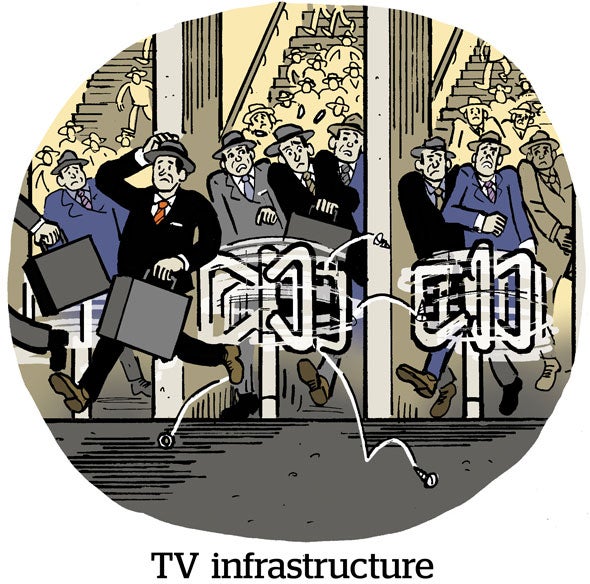
Television Tunnel Vision
Amazon’s way into TV advertising ran through its Fire TV stick business and Amazon Prime Video once the program launched ads.
Its focus was on owning media properties, including the TV and movie studio, that would produce first-party ad inventory opportunities. Twitch was another such example of an owned-and-operated video ad supply channel.
Walmart has big plans to foray into the TV ad market. But its entry points are via the Vizio smart TV manufacturing business ($2.3 billion) and streaming video ad tech startup Vibe.co ($1.4 billion), as Adweek reports.
Vizio generates some first-party ad inventory, but what those companies bring, Vibe in particular, are large bases of advertisers that aren’t endemic to Walmart (as in, they sell products or services that aren’t available at Walmart).
Vibe has thousands of small brand or local service advertisers who are eager for CTV and don’t sell in Walmart. What they’re going to find, though, Walmart Connect GM Ryan Mayward told an Advertising Week crowd this week, is that “adding our data into their optimization capabilities is going to prove that commerce insights will drive stronger outcomes for brands, whether they sell products at Walmart or not.”
Butt At What Cost?
Amazon doesn’t just know your clothing size; it knows the shape of your butt.
And this is one of the moments where “right person, right time” could actually do more harm than good.
Getting ads for highly specific products – say, jeans designed to accentuate one’s derriere – can go one of two ways: The retargeting or personalization can generate a sale, or someone feels weirded out.
Amazon users no longer have to wonder. Since May, Amazon has been beta testing a new “About You” page that allows users to see assumptions that Amazon has about their behavior and interests based on data it’s collected, Fast Company reports.
The assumptions include everything from hobbies (like reading contemporary fiction), physical attributes (like the aforementioned flat buttocks, which was categorized as a “product preference”) and sometimes oddly specific interests (case in point: muscular brunettes?).
The new “About You” page was, for many, the gateway to understanding just how much personal data Amazon collects on its users. Amazon’s privacy guidelines state that, in addition to search and purchase data, the company also tracks everything from user reviews to conversations with Alexa to connections to third-party businesses.
Demonizing Demonetization
A few years ago, no brand wanted to be caught monetizing online disinformation.
Now, though, advertisers are avoiding being associated with efforts to crack down on disinfo. And that aversion has spread from commercial brands to world governments, as US leaders continue to politicize anti-disinformation.
Multiple countries have withdrawn their sponsorship of #Disinfo2026, a European conference on countering disinformation, amid pressure from the Trump administration, The Guardian reports.
Lithuania’s and Canada’s foreign ministries, as well as the European External Action Service, pulled their logos from #Disinfo2026’s official conference materials. The logos were hastily taped over, suggesting a last-minute decision.
The Trump administration took issue with an event panel in which three American speakers, including a former CIA officer, were set to discuss the US as a source of “foreign information manipulation and interference” in the EU.
It’s the latest example of the US-based pushback against collective attempts to combat online disinformation.
You might recall House Republicans holding hearings suggesting the ad industry’s demonetization of disinformation was actually meant to suppress conservative speech. Or the State Department sanctioning EU anti-disinformation leaders. Or the US government approving Omnicom’s acquisition of IPG on the condition that the agency not make brand safety decisions concerning political speech.
No wonder the ad industry doesn’t talk about demonetizing fake news as much as it used to.
But Wait! There’s More!
What’s up with the AppLovin/Unity animosity? [Digiday]
Meta is rolling out new AI tools for detecting ads and accounts that direct people to child sexual abuse material. [TechCrunch]
In other Meta news, a Texas gay bar blames Meta’s revamped content moderation for its social accounts being deactivated. It’s part of a larger trend of queer bars and nightclubs disappearing from Facebook and Instagram. [Chron]
Even the supposedly teen-friendly version of ChatGPT may not be all that safe for minors. [Axios]
McDonald’s has been hit with a federal lawsuit over its AI-driven pricing tool that sometimes sets markedly different prices for the same menu items across franchises. [AP News]
Branded raves are the new live events marketing craze. [WSJ]
A new site-blocking bill has been introduced to Congress that would give copyright owners the ability to block Americans’ access to foreign sites. It specifically targets VPNs. [Electronic Frontier Foundation]