Doctoring The Ads
Days after a glowing report in The New York Times, telehealth startup Medvi faces scrutiny about its use of deceptive AI-generated ad creative.
Medvi was profiled as an example of AI efficiency, having reportedly earned $400 million last year and a projected $1.8 billion in 2026 with just two employees.
But a quick follow-up piece in Futurism revealed that Medvi’s advertising practices needed a health check.
The startup routinely uses fake AI-generated before-and-after pictures to promote weight-loss drugs. Some images appeared to derive from real weight-loss photos scraped from the internet and altered by AI. Medvi distributed these ads through more than 800 AI-generated social accounts posing as doctors.
Beyond the obvious brand safety and ethics concerns, Medvi used people’s likeness without permission and falsely advertised the results of a drug that could negatively affect patient health.
The issue of AI-generated marketing treachery isn’t new. AdExchanger columnist and Zefr Co-CEO Rich Raddon wrote last year about how the economics of AI-generated content, with infinite output at minimal cost, created a wave of slop that’s hard to mitigate.
But we guess even premium publishers can produce slop sometimes.
First Flight
The retail media revolution has forged many new monetization partnerships.
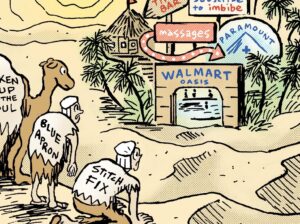
Marriott and United are intuitive partners via their respective data and advertising businesses, and a Walmart+ membership now includes an ad-supported Paramount+ streaming subscription. Uber One, meanwhile, the rideshare company’s paid membership offering, is a natural partner for Disney+. You know, “Here’s a 24-minute episode to fit your ride.” The pair also previously had a promotional bundle.
One reason these “plus” partnerships are based around subscriptions or memberships is so that consumer profiles can be matched and there’s already a paid relationship.
While most of these “plus” partnerships revolve around entertainment or retail memberships, one category of subscription business – news publishers – has largely been left out.
To be fair, Instacart+ (they have one, too) signed a deal with The New York Times last year, though, frankly, it’s a highly advantageous arrangement for Instacart.
Now, NYT is back with one of the first truly notable news partnerships tied to a retail or membership program.
Travelers in Delta’s loyalty program (i.e., SkyMiles members) who log into a flight’s Wi-Fi can unlock 24 hours of free access to the NYT’s portfolio, including games, recipes, news and sports, “so they can keep reading, listening and playing, wherever their journey takes them,” per the Delta release.
It’s a smart move that hints at where retail media is headed next – into experiences and environments where attention is already captive.
GolfTube
How can golf overcome its perception as a sport for rich old dudes? By pivoting to social influencers, of course.
A new golf video creator network, Source Golf, is coming to YouTube, Sports Business Journal reports. It’s the brainchild of Source Media Group, which creates YouTube-based media networks built around sports personalities.
Source Golf will aggregate YouTube content published by former PGA and current LIV golfer Bryson DeChambeau (whose channel boasts 2.6 million subscribers), former PGA-ers Wes and George Bryan (800,000 subscribers) and golf influencer Grant Horvat (1.6 million subscribers). Source Golf will also sell ad inventory on behalf of these channels.
The network is the latest example of golf embracing YouTube as a growth channel. Tutorials from professional instructors and players on how to pick the right clubs or perfect your swing abound on the platform, alongside trick shot compilations and blooper reels.
For instance, DeChambeau has long sought to raise his profile with gimmicky YouTube videos featuring celebrity guests or attempting to break course records.
Meanwhile, both the PGA and LIV have recently launched tournaments specifically for influencers and YouTube creators like Horvat, who has declined multiple pro tour invitations because TV network broadcast agreements won’t let him film social content.
But Wait! There’s More!
The Senate Leadership Fund, which is the Republican Party’s top super PAC for Senate campaigns, will spend at least $342 million on advertising in eight battleground states. [Politico]
Wasn’t this a “Succession” episode? Paramount Skydance secures nearly $24 billion from Saudi Arabia, Qatar and Abu Dhabi wealth funds to back its takeover bid for Warner Bros. Discovery. [WSJ]
“Silicon sampling,” as in the use of AI-generated answers to save time and money on polling real people, is poised to ruin public opinion polling and survey-based market research. [NYT]
SEO firms are gaming AI recommendations by publishing listicles that tout their clients as a top choice for a given problem. It works because AI can’t yet distinguish organic product rankings from content marketing schemes. [The Verge]
A former BuzzFeed journalist weighs in on why the company – and the concept of millennial-targeted news – is on its last legs, and also why there’s been no Gen Z equivalent. [The New World]
How Thomson Reuters data powers ICE and Palantir. [404 Media]