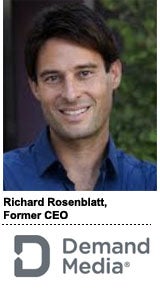
 Demand Media co-founder Richard Rosenblatt is stepping from his roles as chairman and CEO of the content aggregator. Read the release.
The company has worked for years to be perceived as a curator of “prime”, albeit utilitarian content instead of being perjoratively identified as a keyword-laden “content farm.” Rosenblatt’s departure suggests no immediate wholesale change in direction, since he’ll be replaced in the CEO seat on an interim by Shawn Colo, who co-founded the company with Rosenblatt in 2006. The chairman role is being taken by DM board member James Quandt, whose background includes co-founding private equity firm Thomas James Capital, where he also served as a managing partner.

Just a few short years ago, the content aggregation model was experiencing a great amount of attention and excitement as a way to match the rise of audience buying and the migration of publisher dollars to search marketing. A few months before DM went public, Yahoo had bought DM rival Associated Content — now known as the Yahoo Content Network — for $100 million and the NYTCo’s About Group was the keystone of that company’s digital business. But Yahoo has done little with that service, which has since passed through a number of CEOs, and in 2012, the NYTCo sold About following several quarters of revenue declines.
In part, the problem these kinds of services faced was a lack of brand differentiation and that the content was driven more by keywords than actual editorial thinking. DM, among others, began talking more about quality assurance in its articles. It also looked to strike content deals with celebrities like Tyra Banks and Lance Armstrong (when he was still a bankable name, of course) and began acquiring cool, niche ad networks like IndieClick. It also ventured into content syndication with Gannett’s USA Today, which hoped to attract the additional traffic from DM’s popular sites like eHow and Cracked.
Joanne Bradford, DM’s former chief revenue officer who left in May to become president of Hearst’s San Francisco Chronicle, had been the architect of the company’s focus on developing a more premium brand strategy that looked to tie itself to social sharing as opposed to evergreen content connecting consumers through search keywords. That plan was notable during Bradford’s last quarter, as the company posted a decent 9% gain in revenues that were partly attributed to the acquisition of ecommerce marketplace Society6.
“We believe that search algorithms and distribution on Facebook, Google, and mobile devices will change every single day,” Bradford told AdExchanger in August 2012. “We know the changes don’t go in our favor, but we know we can figure out what we need to do in order to meet the consumer across Facebook, being discovered on search, placing our content on YouTube and Twitter.”
Given the nature of how users find content, it’s hard to see what else DM can do to improve its situation and its strategy. But that will be the challenge for Colo, who in addition to the interim CEO duties is also taking on the temporary role of president. He’s mainly served in the general capacity of EVP, corporate development, so it’s likely that that DM will search for someone more on the social side of the business rather than content creation for its next moves.