 The four-day, Advertising Research Foundation’s Re:think 2011 show was up and running in New York City today. And, there were few media buyers and sellers in sight as the analysts and researchers of the media world took over the Marriott Marquis to share notes, agree to disagree, and see if what’s in-house is up-to-date.
A forum panel tantalized attendees with its title – “Is My Digital Ad Working?” – and consisted of three different groups of presenters whose answer seemed to be… “not exactly sure.” Given what one might imagine about the empirical world of research, it’s amazing to see how the ad research business in digital is still wide-open as there are few clear insights or metrics to report the efficiency of online display ad, brand campaigns, in particular.
But, that isn’t to say there isn’t any data. It’s digital, after all, and there’s tons of data which can result in many different insights within segments of larger campaigns. The story is clearly … complex.
Sibel Satiroglu and Suzanne Leighton, European-based ad researchers from HP, led off and presented results from their recent paper which delved into the proper metrics for digital ads and used their company’s digital ads for printers as a basis for learning.

In reviewing the results with audience members, Leighton offered that there was only one reason to use click-through rate (CTR):
“CTR can be used as a measure of creative and media performance [for] tactical optimization. That means we can look at the CTR rate of one creative versus another creative in a similar placement. It could help us make a decision about which creative seems to be generating a better response.
Note: “could.” Both researchers were skeptical that even this comparison could yield benefits as Leighton admitted later that even the “creative comparison” application has its limits, “The [analyst’s] view may be that if the ad isn’t clicked, then the ad has communicated the required information properly. -so then the click doesn’t mean anything.” We’re back to Print!
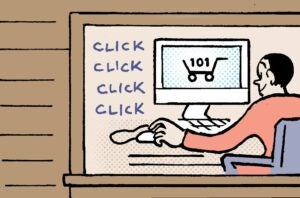
The genesis for the team’s research appeared to be it’s own struggle to communicate with management regarding the performance of digital ad campaigns. A key challenge was that company management believed (may still believe) that digital is more accountable than any other medium and therefore digital metrics such as CTR are an important indicator. Obviously, education continues needs to happen at the top.. it’s doubly hard when the minions are the ones doing the teaching – executives swallow pride here.
Much like TV, the digital researchers said that when they create a dashboard for the executives to review, they do not include CTR, but prefer reach and frequency. Is the GRP far away?
comScore’s Josh Chasin chimed in at the end of the HP researchers prez and briefly reviewed some of the “Natural Born Clickers” data that his company has offered in the past and showed clickers can be a useless lot and cen get no respect in the world of brand research!DR is a different story, but people weren’t talking about retargeting today. I have a feeling there would be plenty of skepticism of the true value of the last click in retargeting. Today’s mantra was more about getting scale and driving people down the funnel – starting at the very top – and then finding metrics to show performance.
Next up came researchers Edwin Wong of Yahoo! and Yaakov Kimelfeld of MediaVest who offered a study on how attitudes of the user affect performance. It’s attention economics! And AIDA – the funnel marketing acronym not the opera – was front-and-center. How does the marketer get their attention (“A”), then garner their interest (“I”), followed by spurring their desire (“D”) and then cause an action (“A”). AIDA!
Wong and Kimelfeld explained their view that there are a range of engagement types – seven in all from shopping to entertainment. Each type requires different messaging… let alone messaging according to where they are in the funnel – and at scale.
Finally, comScore’s vp of TV sales Joan FitzGerald announced her company’s intention to create “single source media information” where the consumer, who is a member of an under-development comScore panel, is being tracked between media types – the computer and the TV. But, complexity still reigns as the audience pointed out – different people use the computer. Different people use the TV. Hey what about work versus home? Complex!
By John Ebbert