
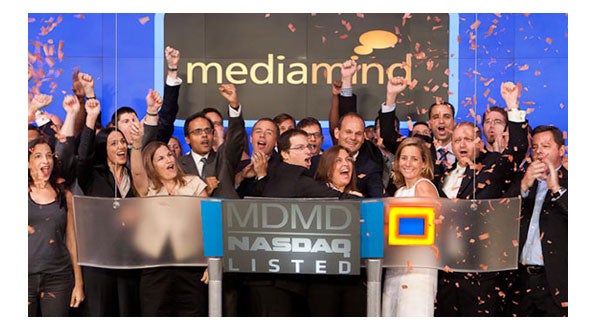
 Yesterday, media buying technology company MediaMind (stock quote: MDMD) offered its stock in the public markets for the first time ever as the company’s IPO priced 5 million shares at $11.50 – well below the original $14-16 price range that the company was shooting for a week ago. As of this writing, the stock was trading at $10.76. Read the original prospectus.
J.P. Morgan, Deutsche Bank Securites, Stifel Nicolaus Weisel, Pacific Crest Securities and ThinkEquity all participated in managing the offering.
With approximately 17.9 million shares outstanding after the offering according to the S-1, today’s stock price puts the valuation of MediaMind (formerly Eyeblaster) at around $192 million with first half 2010 revenues of about $37 million. In comparison, ad network and technology company InterCLICK (quote: ICLK) has a market cap of approximately $84 million today and revenues of $36 million for the first half of 2010. Read the press release.

Given the $192 million market cap, did the bar just get raised for DSP acquisition prices from the $70-$80 million set by Google’s acquisition of Invite Media?
Looking at the IPO, MediaMind successfully raised $57.5 million and CEO Gal Trifon said that the new funds will be used in part to fuel acquisitions in the mobile and social spaces, which will add to his company’s goal of providing a cross-platform, agnostic, media buying solution.
Trifon said, “As far as mobile goes, interactivity, targeting, commerce is interesting to our customers – and these are the type of capabilities we will be interested in (regarding acquisition potential). Social media is another area of great interest: measuring reaction of consumers to brand messaging, benefiting from viral distribution more effectively, benefiting from better targeting and social media based on consumers’ interests. These are all areas of great opportunity that are under-deployed by the entire industry.” Trifon suggested that a cross-platform offering remains critical in order to provide a scalable solution to marketers.
When asked about how the digital ad industry will evolve 5 years from now, Trifon expects that media spend will significantly increase in digital and so will the use of technology to make it happen. “The trend as far as we see it: the media becomes more complicated, more fragmented and the share of media that is managed by technology will grow. (…) We believe that clients, in general, prefer to consolidate around platforms. Using multiple solutions for different aspects is overlaying the media fragmentation with technology fragmentation.”
By John Ebbert








