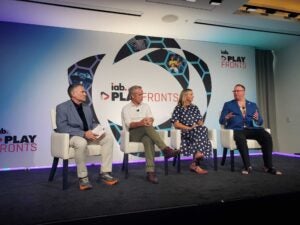
Bob Arnold, associate director, Global Digital Strategy at the Kellogg Company, got a huge round of applause during a talk about the cereal marketer’s approach to programmatic buying when told the crowd at the IAB’s Advertising Technology conference not to talk to bring up the topic of banner ad clicks in a meeting with him.
“We don’t care about clicks because there is no relationship to sales for a brand marketer,” Arnold said. ” If someone comes in talks about clicks, we tune them out and that’s pretty much the end of the conversation. We are a brand marketer and the industry needs to move beyond that.”
Striking a theme that’s often heard at IAB events about the need to reform online advertising as a more brand-friendly space, as opposed to primarily serving as a direct response medium, Arnold also sought to make the case, in a presentation with Chip Scovic, head of sales at Google, that programmatic buying can inspire advertisers to spend more on publishers premium inventory, even as they aim to drive CPMs downward.

During the presentation with Scovic, who runs DoubleClick Bid Manager – the DSP formerly known as Invite Media — showed data that Kellogg’s eCPMs went from a dollar to around 48 cents over the course of a year of working together, while the company’s internal ROI figures increased fivefold.
Perhaps trying to reassure any publishers in the audience, Arnold said that they would ultimately benefit from programmatic buying. “When we talk about CPMs going down, it sounds like race to the bottom,” he said. “But we have a better idea what’s valuable to us and we’re willing to pay for that. We’re not looking for the lowest CPM, we’re looking for the most cost-effective CPM.”
He admitted that when Kellogg first explored programmatic buying with several players before choosing Google and Invite Media, lower CPMs were indeed the focus. ”
“We looked at what ad networks and other ad tech providers were doing in the space and thought we could do it, but our managers wondered if we could be as effective,” Arnold said. “We decided to go with Google and Invite. A year later, ROI increased fivefold and if you have those kinds of results, it’s clear that this is more than just an efficiency play.”
Talking about the strategy, Scovic and Arnold laid out five points:
— Find the right strategy and targeting: how are you going to build programmatic in holistic display media mix
— Getting the right measurement: Kellogg relies on a range of KPI metrics and works with comScore whether targets have been hit
— Form a strong partnership: There are multiple players and technologies you need to work with, so rather than send out an RFP every time there’s a new campaign, keep in constant contact and develop a long-term and short-term set of plans. “Once you become a partner of ours, we want to make you a success. No more bidding for campaign work,” Arnold said. “We just create an audience brief and hand it over to the team. We talk every week about what’s working and what’s not.”
— Investment in the organization: Marketers have been developing internal technologies for a long time, but it’s no good if no one knows how to use them and if they’re not upgraded frequently. “Many companies are still employing 15 year-old buy and sell models, even in programmatic buying,” Arnold said.
— Fine tuning: Test and iterate, then do it all over again.
But in the end, the old fashioned work of making ads is still the key to success. Targeting just makes sure the value of that creative gets to where it’s supposed to.
“From a strategy standpoint, marketers need to create the right message and deliver it when the consumer is most receptive,” Arnold said. “Many think creative is most important, 50 to 80 percent of the value of an ad campaign is in the creative. Finding the right consumer is where programmatic buying fits. We’re still trying to learn when the right moment is, but basically, it’s the lean back moments when she’s consuming relevant content.”
By David Kaplan