 “Data Driven Thinking” is written by members of the media community and containing fresh ideas on the digital revolution in media.
Today’s column is written by Matt Shanahan, SVP of Strategy for Scout Analytics, a behavioral analytics platform for publishers.
As Mary Meeker of Morgan Stanley recently pointed out, 28% percent of consumers time is spent online yet only 13% of ad spend is there. The percentages are out of whack by approximately $50B. Contrast that to TV where consumers spend 31% of their time but garners 39% of ad spend. For all the talk of performance improvements with audience buying and selling, there is an overlooked topic — attention. The share of attention given to ads in TV and other channels outperforms online. Consequently, attention economics drives dollars into those channels. Online advertisers and publishers have a $50B opportunity and improving impression quality will be critical. Maybe that statement is obvious, but it is not how the market behaves today.
Attention is one of the few scarce commodities on the Web. Even though the mobile movement creates more time to leverage the Web, an individual’s options for news, entertainment, socializing, purchasing, and learning are exploding, and like it or not, any one person has a limited amount of attention to provide on any given day. Attention simply doesn’t scale like the web does.

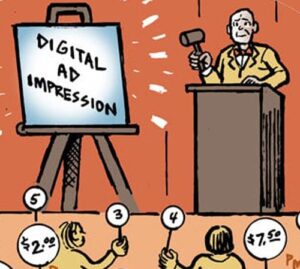
In attention economics, revenue for publishers is predicated on building a specific audience attention share and then monetizing it. The business model is dependent on building and retaining the attention of their audience which means they need to cultivate loyalty. For their part, advertisers are constantly hunting for where they can grab the attention of their target consumer. Now, it’s not that a publisher can actually sell attention, but the publisher can sell an impression, an attention-getting opportunity. Specifically, a publisher sells advertisers the opportunity to compete for the attention of the right audience in the right context (i.e., placement). In this model, the customer is the advertiser; the manufacturer is the publisher; the product is an impression; and the raw materials are content and audience.
While insertion orders are purchased more and more based on attributes of placement and audience, these purchases assume that the impression quality produced is a constant (i.e., pretty much the same). But impressions can vary dramatically by audience member and by placement. In attention economics, insertion orders should be bought and sold based on the placement, the audience, and the quality of the impression.
Today’s audience buying and selling focuses on defining inventory by intent and demographics data about the audience. And while the data movement in online advertising has produced more targeting data, publishers and advertisers have generally ignored impression quality. Drive-bys and skimmers comprise a huge number of impressions; provide little attention-grabbing opportunity; and yet cost the same as an impression to a loyal reader. That doesn’t make sense for the advertiser or the publisher. Of the target audience, which are skimmers? Which are readers? Which ignore ads? Which consider them? What topics or creatives grab their attention? The answers to these questions are knowable through the session data of each visitor. Understanding the data can make a significant improvement in the performance of an ad. In addition to placement and audience, impression quality needs to be factored if the attention economics of online advertising is to compete with other channels.
Generally, the integration between content and ads is not attention-getting. The noisy nature of multiple ads competing for visitor attention makes visitors tune it out either mentally or with the help of the browser. Combined with the constrained real-estate provided, a high percentage of these ads are simply not effective. Publishers and advertisers can change that by architecting a better experience. The Sports Illustrated HTML5 prototype shows how advertising and media can be integrated to create a richer, more attention-getting experience. Sports Illustrated creatively wove an ad into the experience so that it is considered by the reader in-stream rather than relegated to the top, right, or bottom with 10 other ads. Canon’s ad in the prototype is useful, articulates a clear value proposition, and is creative. I am a photographer and would have definitely “used” the ad. That is just one idea. There is tons of room for innovation in advertising as seen by the recent EarlyBird promotions at Twitter. The publishers and advertisers that innovate the experience will improve their competitive position in the attention marketplace.
In Q1 2010, 5% of all impressions were search ads garnering nearly 50% of the online advertising spend. Searchers are willing to give their attentions to the ads because intent data and ad integration is useful. Display advertising can do much better, but impression quality is key. Online display has a huge opportunity, a share of $50B, if advertisers and publishers consider the factors that influence attention economics.
Follow Scout Analytics (@ScoutAnalytics) and AdExchanger.com (@adexchanger) on Twitter.