

 It’s been six months since Facebook unveiled a new mobile-centric ad network offering at its F8 developer conference.
The message then and over the summer was clear: We’ll take our time ramping up the new Facebook Audience Network, from both a supply and demand standpoint. But as of Tuesday, Facebook said it’s ready to demonstrate the firepower of its fully armed and operational ad network. (Official blog post)
Recently rolled out to all advertisers and developers, FAN represents a compelling new data layer in the mobile ecosystem, where much of the supply is still thought of as “dumb impressions.”
And it’s not only data Facebook is bringing. The company aims to offer a range of compelling creative formats as well.
In its early form, FAN was restricted to Facebook’s well-known app install ads, but the company has gradually expanded the formats and now offers a range of ad types, including banners, interstitials and native ads. It also offers so-called “link ads,” where a user taps to open a mobile browser as opposed to an app-based ad.

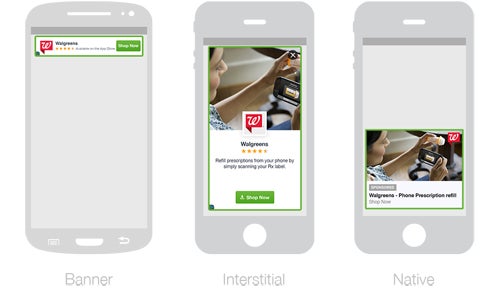 From the marketer’s standpoint, Facebook can be bought like any other product in the Facebook advertising family.
“Whether you use the creation tool, whether APIs, whether PMDs, whether Power Editor, it’s the same,” said Sriram Krishnan, product manager for Audience Network at Facebook. “You check a box that says, ‘Extend my ads to partner apps.’ We spent a lot of time to make it super easy.”
And that stands to reason. The success of FAN will largely depend on how many ad buyers choose to use it, and for the bulk of Facebook’s 1.5 million active advertisers, easy adoption will be of paramount importance.
Facebook is citing some impressive yield numbers for individual developers during the rollout period. Shazam claims to have increased overall revenue from ad networks by 37% since signing on with FAN. And Glu, the developer of an app called “Kim Kardashian: Hollywood,” said Facebook is generating CPMs twice as high as other unspecified “leading ad networks.”
Meanwhile, marketers are amped as well, claiming Walgreens increased the reach of its ads by 5% while improving its click-through rates by 4% to 5%. And HarperCollins was able to buy 16% more impressions once it started buying on FAN.
But are 37% to 100% CPM improvements typical of publishers monetizing through FAN? And are all Facebook advertisers so pleased with reach and performance? “Publishers tell us we are one of the top, if not the top, networks they work with,” Krishnan said.
Facebook is declining to provide cross-network data. Likewise, Facebook is not saying how many developers are surfacing inventory through FAN nor how many of its advertisers have “clicked the box.”








