The era of “managed decline” is over; the era of existential clarity has begun. We are no longer guessing what the post-platform world looks like. We are living in it.
Over the last 12 months, the media industry has watched referral traffic flatline and AI crawlers strip-mine our archives without so much as a thank-you note.
The leaky P&Ls of 2024 burst open, gushing red ink as the internet’s foundational relationships were rerouted, effectively condemning the old media business model to demolition.
But there is a powerful lesson to be gained amid the rubble. Despite the algorithmic chaos, we are still here. The threat of AI is no longer a passing storm to be weathered; it is the new gravity of the internet – an unrelenting force that compels us to evolve.

2026 won’t be about waiting for the platforms to apologize. It will be the year that publishers finally remember how to walk without them.
1. Ruthless independence
After years of building on rented land, publishers are finally done. The collective trauma of 2025 will harden into a strategy of ruthless independence.
We will continue to use social platforms, but with zero loyalty. It is fine to amplify your IP there, but every post or video must be designed solely to move the user off that platform and into an owned experience – an email, an app or a website that is worthy of loyalty. The metric of success is no longer “viral reach”; it’s “sovereign reach” – as in, the audience you can contact without asking an algorithm for permission.
2. ‘The Great Unbundling’: From content to connection
Once you extract that audience, you have to give them a reason to stay. On an internet where search engines are drowning in AI sludge and social platform cohabitation has become what you might call a quid pro nihil, we’re overdue for an examination of how media companies can become influential again.
The reality is that people follow people. In a world of synthetic content, the only thing that retains value is unfakeable human presence, an asset that publishers traded long ago for algorithmic scale.
Consequently, the masthead will continue to lose power while the byline gains it. Successful publishers will pivot to becoming “Talent Universes,” building subbrands, newsletters and podcasts around their star journalists.
A media company’s role is to create, distribute and monetize IP, and that content must be an experience that AI cannot commoditize. Premium IP is what spins the flywheel – and to create it, you need your talent to be present, whether that’s physically or digitally.
3. Supply-chain collapse
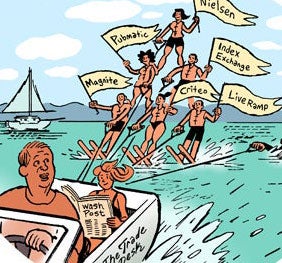
2026 will mark an extinction-level event for advertising intermediaries that don’t add unique value. The market will no longer support a partner who takes a 15% cut just to pass the baton with jazz hands.
Buyers are no longer willing to subsidize inefficiency and are bypassing middlemen to flex absolute control over the architecture and margin.
This shift will contribute to the rise of agency curation desks. To reclaim planning budgets, holding companies will build their own systems directly on top of SSPs. But unlike the trading desks of 2015, where data leakage and cookie-chasing commoditized publishers, this time, intelligence and targeting will move to the supply level. Meanwhile, lightweight DSPs will serve as mere transaction executors.
For publishers, this trend reinforces the idea that signals are everything. If you (and your signals) aren’t on an agency’s curated inclusion list, then your bid requests won’t even reach them.
4. The sales and packaging resurrection
With the collapse of the supply chain, open auction programmatic will become more challenging for everyone. Your legacy brand name no longer makes you a must-buy. You have to prove the quality of your experience.
Publishers must learn how to sell solutions, not products. Sales and ops teams will return to actively packaging high-quality supply enriched with proprietary signals, including supply-chain directness, attention score, identity and more.
Whether inventory is packaged via a Deal ID (curation) or an insertion order, the discipline is the same: using data to tell a story about a specific audience. The winners will be those who can articulate why their inventory is worth choosing.
5. Zero or hero?
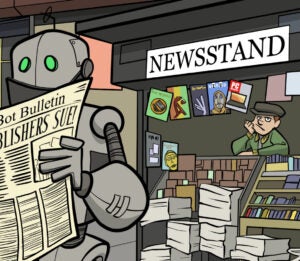
While we fix the pipes, the industry will also move to defend the reservoir. We will see a shift toward a zero-tolerance policy on AI crawling.
A “digital blockade” is technically difficult and risks de-indexing publishers from search. But de-indexing our content is the nuclear option we may have to face. The choice will become binary: Block the bots and risk a traffic dip or allow them in to devour content and train the very models designed to replace us.
The goal of such a blockade is to force the AI giants to the table. If the premium web goes dark to the AI models, their “freshness” degrades – forcing a negotiation for licensing rather than theft.
6. Social networks try to recolonize the open web
Having maxed out ad loads inside their own apps, giants like Meta, TikTok and Pinterest will aggressively expand their infrastructure to capture time spent elsewhere, specifically on connected TV (CTV) and the open web.
Pinterest’s acquisition of tvScientific is a clear sign. By acquiring a CTV ad server, Pinterest isn’t just selling “Pins” anymore; it’s pitching advertisers on the ability to find its high-intent social audiences watching “Yellowstone.”
The social giants are saying: “You love our algorithm’s performance inside the app? Now let us apply that same logic to the rest of the internet.” For publishers, this will look like a lifeline of high-value revenue, but beware: It’s a Trojan Horse. By relying on this demand, we are training their graphs (again) on our inventory. Caveat venditor indeed.
7. Ads in AI
Unfortunately, 2026 will also bring a new era of pain when ads creep into LLMs and the enduring (but stagnant) web-display budgets leak into this nascent channel. But brands won’t be the only ones paying.
As AI Overviews become Google’s default search interface, the “organic result” will effectively vanish. Enter the “Sponsored Citation,” a model where being the “source” in an AI answer is an auction, not an accolade. Google will effectively charge publishers to be the footnote in their own stolen content.
The question for 2026 isn’t “How do I rank?” It’s “Can I afford to bid on my own survival?”
The grand alliance
But here’s one hope for 2026: The supply chain civil war must end.
For too long, we have treated the relationship between buyer and seller as adversarial, but that narrative is dead. The real battle isn’t publishers versus advertisers; it’s the open web versus the walled gardens. In the past, we fragmented while the giants consolidated. We cannot afford to replay that record.
Advertisers constantly bemoan their reliance on Big Tech, yet they continue to pour money into closed loops because it’s “easy.” If buyers want a viable alternative, they can no longer stand on the sidelines; they must help build it.
We built the open web together, but we entrusted the platforms with the keys in exchange for convenience. It’s time to stop acting like guests in our own home and remind them that we own the deed.
For more articles featuring Scott Messer, click here.