
 “The Sell Sider” is a column written for the sell side of the digital media community.
Today’s column is written by David Kohl, president and CEO at TrustX.
The industry has been doing the math wrong.
For years media buyers have tolerated the waste everyone knew was part of cheap CPM media buys because, well, they were so blessedly cheap.
The back-of-envelope calculation was simple. Sure, that $5 direct private-marketplace deal offered more prestige, content affinity, targeting and perhaps more accountability. But the sheer cheap scale provided by the $1 open market buy at a fifth of the price easily made up for the ad getting in front of some (maybe most) of the wrong eyeballs.
And it was quite likely that a good number of those ads would make their way to the same viewers as the much pricier private-marketplace buy anyway. Massive waste was baked into the equation.
No doubt 2017 has been a wake-up call to brands and agencies about how risks abound in open programmatic environments.

In 2018, a recalculation is needed. There is deeper and more complex math emerging around the real and hidden costs of buying into a bottomless market of cheap programmatic inventory.
Waste has a cost.
Let’s start at the bottom of the barrel. Every dollar spent in the cheap, open market is effectively underwriting the very system of bot-driven and fraudulent traffic we claim to loathe. In its latest 2017 report on ad fraud, the Association of National Advertisers (ANA) acknowledged a 10% decline in bot fraud activity, but still pegged the global cost at $6.5 billion. Nine percent of display traffic and 22% of video traffic remain fraudulent.
Here’s another way of reading these figures: So long as it regards fraud as a cost of doing business, legitimate media budgets are unwittingly financing a worldwide criminal enterprise of bad actors to the tune of billions of dollars. It is a kind of passive collusion.
One level up is the occasional embarrassment from your pre-roll mistakenly preceding ISIS propaganda on YouTube. For too long, these seemingly inevitable but often unnoticed hiccups of digital efficiency rang up incalculable brand-equity costs. What’s changed is the veracity of consumer reaction when brands fuel fake, racist and offensive content.
Consumer groups, such as Sleeping Giants, keep a watchful eye on advertisers and tech providers that fund socially destructive media. In the last 12 to 18 months, these consumer-led watchdogs began to actively call out advertisers for their loose brand-safety commitments.
Wider press coverage of embarrassing adjacencies led some agencies and brands to pause their spending on major video networks. The hard cost in brand equity from these incidents may be immeasurable. But they cause very real disruption to media planning and an overall erosion in everyone’s trust in the digital media economy. Brands are now being held accountable – in real time – for their roles in supporting this economy.
These front-page costs are just a small slice of the complex bill advertisers ring up for the privilege of too-good-to-be-true CPMs. The programmatic supply chain is home to thousands of advertising technology companies that deflate brands’ media buying power – each by a few pennies.
Every dollar spent in the programmatic ecosystem perpetuates the so-called tech tax that siphons off at least 50 cents of every open programmatic media dollar. Whether or not the ad reaches its target audience, and whether it is served into the viewable window or below the fold, demand-side platforms, supply-side platforms, data providers, viewability and verification providers, tag managers, retargeters, optimizers and others all take their few cents. And almost all do so on every transaction.
That cascading series of small costs that chisel away half or more of working media value incentivizes a system that thrives on keeping the fuzzy math for waste fuzzy and an obtuse tech stack obtuse. Or as Bob Liodice of the ANA frequently says, referring to a phrase Dave Berkus coined in the 1980s, “Where there’s mystery, there’s margin.”
Ironically, it is the programmatic media buyers – those doyens of algorithms and efficiency – who have a math problem. They have been calculating the costs of cheap media without all of the figures. The real calculus of programmatic media buying not only must include presumed fraud, irrelevant targets and brand reputation. It must also add to the equation the growing tech tax when literally hundreds of billions of micropenny transactions ring up in the massive, virtual cash register that is the entire ad tech ecosystem.
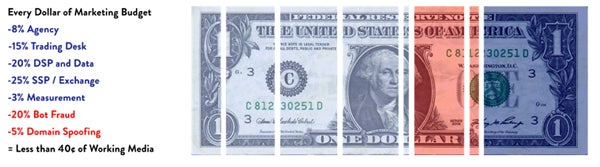
In that equation, $1 adds up to considerably more than a mere buck. The hard cost of cheap, open programmatic CPMs easily climbs a lot closer to the $5 media value you get with far more accountable premium media buys. And when advertisers add in brand equity risks and the costs of perpetuating the complexity and mystery, the math becomes even clearer. Suddenly, the apparently higher CPM rates advertisers pay for premium inventory aren’t really higher at all.
A new and better math calculates all of the costs of programmatic CPMs. And it solves for the real value and buying power available in a future of safe, transparent and trusted programmatic advertising.
Follow David Kohl (@davidmkohl), TrustX (@TrustxAds) and AdExchanger (@adexchanger) on Twitter.







