

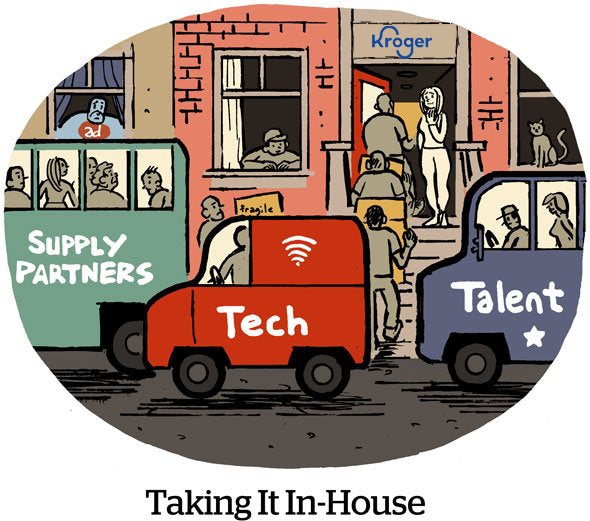
One of the biggest trends of 2014 – ad tech in-housing – is crashing into one of the buzziest trends of 2023: retail media all day long.
On Wednesday, Kroger Precision Marketing (KPM), the grocery chain’s retail media arm, announced plans to bring its self-serve retail media ad tech fully in-house and shared an update on how the project is going.
The platform is now in beta with a handful of clients and will be generally available sometime in the fourth quarter.
Although advertisers will still be able to manage their Kroger retail media campaigns using third-party tools, including from Pacvue, Skai and Commerce IQ, the in-house change should help buyers consolidate spend and make the buying experience less fragmented.
“[Having] too many entry points creates too much friction against the behavioral intelligence we have on shoppers,” said Cara Pratt, SVP of Kroger Precision Marketing (KPM), Kroger’s retail media division. “We’re focused on creating bridges to remove some of that friction.”

Walls coming down
But Kroger putting its own retail media house in order doesn’t solve for RMN fragmentation across the broader market.
There’s been an explosion of media networks over the past couple of years, and ad buyers are wary of adding yet more walled gardens to their media mix.
It’s not surprising, though, that retailers are cautious about providing access to their first-party data, for privacy reasons and because first-party data is one of a retailer’s most precious assets, Pratt said.
Yet the walls are coming down.
Creating a single portal for on-site and off-site media buying should smooth the way for interoperability with other media activation and management software, Pratt said.
And Kroger isn’t the only one. Over the past year, other large retailers, including Albertsons and Walmart, have made moves to consolidate aspects of their retail media operations.
“The fragmentation is starting to dissolve,” Pratt said. “It just takes time because we’ve got decades of operational and organizational practices to unwind to recognize the role of retail media as ‘media’ and not as a separate channel.”
Kroger is also active with the IAB, which is working on retail media standards, although nothing has been released yet. (Pratt demurred, however, when asked whether Kroger would back the retail media standardization framework proposed by Albertsons Media Collective in Cannes last week.)
One-stop shopping
The initial version of Kroger’s self-serve ad platform will span display and search-based product listing ads on its own properties, which can be targeted against “custom ad groups,” such as based on someone’s propensity to buy products within certain categories or even based on a shopper’s flavor or scent profile.
For example, it could be valuable for a laundry brand to know that someone does – or doesn’t – like a particular smell, such as lavender or “April fresh” (whatever the heck that is).
Kroger uses this type of insight to inform organic search results and paid media placements with a focus on attracting new customers.
“The vast majority of our impressions and clicks are to expose consumers who are new to a brand within the last 26 weeks,” Pratt said. “That is a deliberate choice of ours as we look to drive discovery for new products.”
In addition to audience insights, advertisers will also be able to design, customize and activate creative through Kroger’s self-serve platform, as well as save creative and messaging templates to repurpose for future campaigns.
Other bells and whistles include optimization for budgeting, messaging and campaign flighting, and reporting for retail performance metrics, such as household penetration and sales lift.
Although it’s starting with owned-and-operated media, Kroger will eventually extend its self-serve platform to off-site programmatic, as well as via social commerce integrations and streaming partnerships with the likes of Disney and Roku.
Hello and farewell
But self-serve ad tech doesn’t build itself.
KPM has added nearly 100 new roles over the past year to support the launch of its platform, including engineers, product people, data scientists and hires across media operations, customer success, marketing, sales and commercial ops.
Many of KPM’s new hires come from the media industry, including former agency buyers, data science and engineering people from large publishers and dyed-in-the-wool ad tech characters. Some of the roles are still open.
“We’re looking for folks with experience across the buy side and the sell side,” Pratt said, “who really understand the media supply chain, including where the waste comes from and how to make in-flight bidding choices.”
But although Kroger is investing time and resources into in-housing the ad platform, it’s not chucking out third-party partners. Advertisers deserve options, Pratt said.
Still, some relationships are coming to an end, including Kroger’s partnership with Microsoft Advertising, which previously powered Kroger’s self-service ad platform through its commerce marketing platform, PromoteIQ.
“I give a lot of credit to Microsoft – they helped us develop our retail media business – but this new platform gives us the ability to evolve with deeper customizations,” Pratt said. “Kroger will continue to partner with Microsoft in other ways, but we won’t be using their inventory and bid management platform as we look forward.”







