 A “significant jump” in the number of advertisers tapping into programmatic platforms – 39% of advertisers now take advantage of these technologies – indicates interest is on the upswing on the buy side.
According to the Online Advertisers Survey Report 2013 by digital marketing research company Econsultancy in partnership with Rubicon Project, the number of advertisers using demand-side platforms to purchase online display advertisements grew 16 percentage points from the number recorded at last survey in 2011, based on the response of 650 advertisers and agencies globally.
But, despite the growing wave of interest, online ad networks still have strong adoption rates. Seventy-four percent of advertisers bought display advertising using an ad network, up 11 percentage points from the 63% who did in 2011.

 “Although this new [automated] world is taking hold, there appears to be a place, at least for the moment, for online advertising networks and sales houses,” said Linus Gregoriadis, research director at Econsultancy. “I think it’s because a lot of online ad networks are still being used and because advertisers are kind of juggling this older-school program with the new-school programmatic,” but also because networks are essentially being forced to differentiate a bit more and are using data themselves to add value, he said.
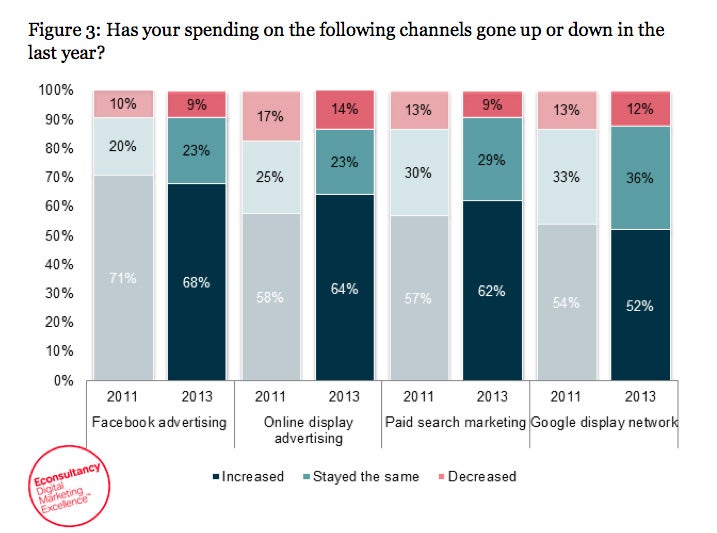
Online advertising spend continues to increase across the board with 64% of advertisers increasing their spend on display advertising in the last year. Most notable, according to the report, is the budget appropriated to Facebook advertising. Sixty-eight percent of online advertisers reported increasing their spend on this platform over the last 12 months.
While Facebook led the pack (compared to general online display advertising, paid search and Google display network) for increases in spend this year, it’s still important to note that the number dipped slightly, by three percentage points, from the 71% figure recorded in 2011.
“There’s a lot of interest in Facebook as they introduce more ad formats and as they add more opportunity for companies to target based on their own first-party data,” Gregoriadis said. Although this report did not get into specifics about general Facebook ad spend vs. programmatic FBX, he noted Facebook’s making “strides recently to increase their mobile advertising revenues, but it would be a great thing from them to see more of a breakdown on where it’s coming from.”
Another key trend outlined in the report is the growth of the private marketplace, which is “quite a new [trend we’ve seen] since we did the report two years ago.” Nineteen percent of advertisers said they have implemented private marketplace deals while a solid 40% have plans to do so.

“I think, because of programmatic buying and automated bidding, there’s a lot more nuance [to publisher inventory], if you like, so there’s more of a scale in ‘good’ and ‘excellent’ inventory,” Gregoriadis noted. “It’s good for publishers — they can make more money for their inventory — and it’s good for advertisers because they get the chance to advertise on properties that might not have been previously in their reach” and the increase in the implementation rate reflects that.