

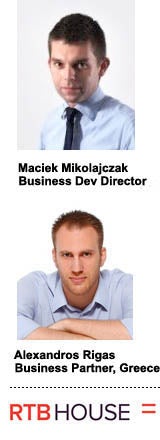
 Anyone interested in a modern-day Greek tragedy should check out the country’s economic situation. But all tragedy ends with catharsis, and it’s why RTB House is upping its investment in the country.
The two-and-a-half-year-old demand-side platform (DSP) from Poland is bringing on a business partner Alexandros Rigas.
“We’re mainly working with shop owners, which is a difference,” said RTB House business development director Maciek Mikolajczak. “In other markets, we work with marketing directors or performance directors. We rarely work with owners if they’re large enough shops.”
That might soon change, Mikolajczak predicts – technologically, the Greek market is about four to five years behind the US. By then, if RTB House strikes now while the iron is hot (even if the country is having trouble paying for it), the ad tech company will be ensconced in the Greek market.
Both Rigas and Mikolajczak spoke with AdExchanger.

AdExchanger: No, but seriously: Why Greece?
MACIEK MIKOLAJCZAK: We started operations in Greece nearly two years ago. And we have global aspirations to be everywhere and to secure business in every country. Our product, knowledge and experience makes us able to propose something valuable for the Greek market, since they’re observing every euro very carefully.
ALEXANDROS RIGAS: Greece is just one of the 33 markets of RTB House. Before the crisis, it was a small market in terms of operations. There are a few opportunities here with companies that aim to expand to Europe. Although Greece might seem like a local market, since shipping and all those goods go into the EU, you can also see it as part of Europe.
So no hesitation investing into an economy that’s gone a little crazy?
MM: Our situation in Russia and the Ukraine is very complicated due to the war situations and political situations. Everything has a strong impact on our business there. The Greek crisis also has an impact on our situation in Greece.
But the goal of the company is to deliver performance marketing and retargeting services to our clients, who are suffering for different reasons. We accept the situation in Greece and we have to live with it. But we believe this situation will be gone sooner or later and the relations built during these difficult times will be very important.
Is it easier or harder breaking into a country with an unsettled economy?
AR: It’s easier. Every client is interested in spending money in the online marketing area. It’s actually easier to approach them and to present how the RTB system works. One of the biggest advantages on our side is that the most important thing for [prospective clients] is our product is based on performance marketing – you pay only for what you get.
MM: The more difficult times are, the more you look for optimization. [Greek companies] are also looking for a measurable means of advertisement.
On the other hand, it’s more difficult because the situation is tight. We’re being paid for what we deliver. We’re not getting paid for branding campaigns. When we deliver it, we’re paid.
How would you characterize the Greek advertising situation before the crisis?
MM: Underdeveloped, not very advanced. And it’s still underdeveloped. That doesn’t mean the Greek industry isn’t ready for it.
AR: Even in 2008, we struggled understanding online marketing. But step by step, we reach a point where we have more educated executives in very crucial positions. And since the market is very small, everyone is sharing experience with the market.
Who are your clients in Greece?
AR: We have almost 25 companies we’re working with. Some are direct lines, some are indirect. We have targeted some companies that are multinational.
Any particular verticals?
MM: Most of them are in fashion. The other one is electronics.
Why fashion?
MM: Fashion is good for performance marketing. First, fashion resellers have quite large margins. Average margin in the fashion industry is 50%, versus electronics, which is 7-10%. Second thing is that the average conversion rate in the fashion industry is larger than other industries. Third, users of fashion shops tend to click more often than users of any other shop. You can simply buy ads for higher prices – or bid higher – because the ROI is higher.
How does selling into the Greek market differ from other European markets?
MM: The decision-making process lasts a long time. Greece needs to spend time on decisions. Many coffees. Many meetings.
AR: Also, the hands-on approach of the owners is much larger than other countries. The investors and owners want to take care of their investments more carefully and see where the money is spent.
You need to know the market very well, and know the right time to approach with all of the events going on here. So it’s tricky.
So when is the right time to approach?
AR: That changes day by day. You have to plan every move ahead. You have to know who your prospects are, who your potential clients can be. Things at the moment not very certain, so everything can change.
But things are calming down now. We see a clear prospect for Greece and this means it’s slowly coming to the point where people are starting to relax from the stress and think about the next steps.








