

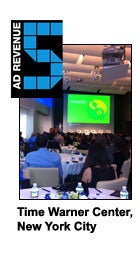
 PubMatic‘s 5th annual Ad Revenue Conference took place today in New York City. Fifth annual. Like the event, the industry has matured over time.
It was only 2010 when RTB was the theme for Ad Revenue. Today’s opening keynote from PubMatic CEO Rajeev Goal stressed “holistic” sales management as technology guides yield management over all channels, guaranteed or not.
Following Goel, MediaLink’s Wenda Millard led a publisher-focused panel that looked at the state of “programmatic buying” and included:
- Paul Caine, CRO, Time Inc.
- Carl Fremont, EVP, Media Director, Digitas
- Teri Gallo, Candreon/Mediabrands Audience Platform (MAP)
- Amanda Richman, MediaVest’s digital president
- Vivek Shah, CEO, Ziff Davis
Amanda Richman began with an answer to what programmatic buying means for the agency as she identified how it’s impacting all digital buying teams, not just the agency trading desk. MAP/Cadreon’s Teri Gallo made the agency trading desk case and said her holding company, IPG, believes this is the way digital media will be bought and sold in the future – which echoed something Omnicom CEO John Wren said recently.

Digitas’ Carl Fremont suggested that programmatic buying has grown 30-40% year-over-year from his Digitas POV. There’s growth or evolution in mindsets, too, as Time Exchange was Time Inc CRO Paul Kane’s new focus in 2012. He said his company’s programmatic buying interests are expanding as is the idea of holistic sales management. He said there was less risk with programmatic buying to his company than the past… meaning sales channel conflict and privacy concerns. Data is the key part in all this, said Kane, as the value of the data unlocks the value of the inventory in a “multi-tier way.”
But, Ziff-Davis’ Shah said advertiser data continues to drive the value. “Can publisher data drive ‘excess returns’?,” seemed to be the question Shah posed to the room. There’s still plenty of room to grow here apparently.
MediaVest’s Richman said that creative remains a challenge in the data-driven ad world, too, even with some innovation around dynamic creative optimization. MAP’s Gallo agreed and didn’t necessarily present that there were a lot of great, new creative solutions out there. Fremont said it’s time to make creative “sexy” with data-driven ads because, in the end, “what gets attention is the big brand work,” according to Fremont. So, the idea here is that brand [awareness] dollars still need to find a way in to the digital data. Predictably, the rest of the panel agreed. There still seems to be few answers on the creative side.
Millard moved the panel next to a discussion on skill sets for the programmatic buying world. Gallo saw the need for an understanding of marketing, analytics and math. Richman said “collaboration” was another important part to building a team. Silos in the agencies have started to become intertwined, she said. Legal, engineering, sociology are all part of the skill sets that Time’s Caine indicated were going to fuel his company’s strategy. “Now we need everything,” said Caine – as Millard also emphasized the collaboration important in all this.
Ziff-Davis’ Shah pointed out the big challenge for the publisher side – let alone the agency side – is getting “world-class engineers” to create differentiated and innovative products. Caine then guided the discussion to a connection with the offline and traditional world as panelists agreed that TV, radio, and yes, print, will be entering into the programmatic buying world progressively. Fremont stressed that one can’t take a full leap with the other (non-digital) channels yet as we’re in a “transition stage.”
Fremont said he wanted to see the buy and sell sides to work together more and provide a give-and-take of data considering the fast moving environment. Richman (the agency) and Caine (the publisher) both agreed that available cross-channel needs to inform both sides – which tied back to the idea of ‘holistic sales management’ – a key theme for the day.







