

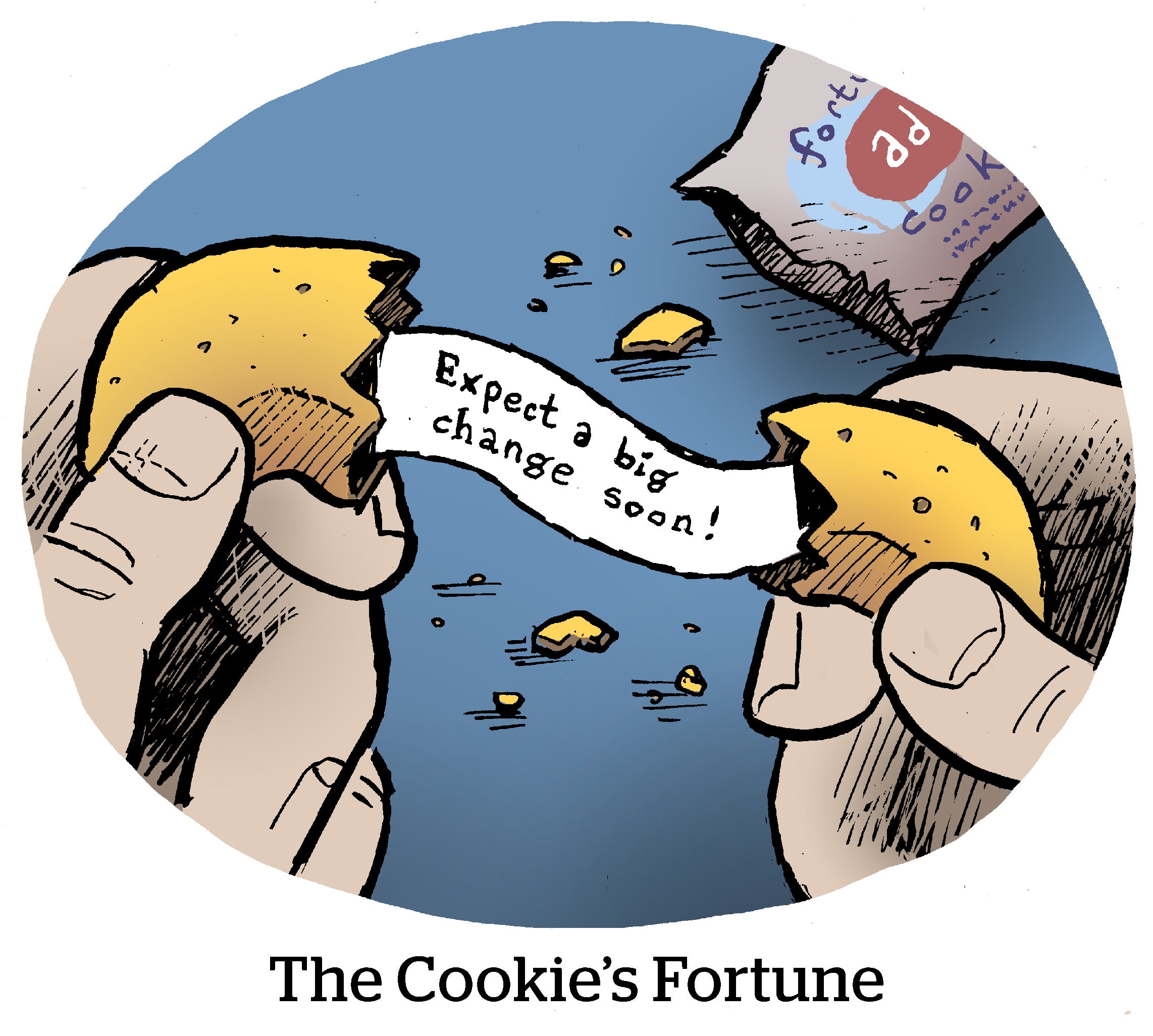
New Year’s resolutions were made to be broken.
But on Jan. 4 – today! – after multiple delays and deadline extensions, Google finally disabled third-party cookies for 1% of randomly selected Chrome users globally, which is the first step in its plan to fully phase out third-party cookies in its browser by the end of this year.
There are roughly 3.22 billion Chrome users worldwide, so 1% equates to roughly 32 million people.
Specifically, Google released a new feature called Tracking Protection that, when enabled, automatically cuts off a website’s access to third-party cookies.

Google has said it’s purposely moving slowly so advertisers, publishers and tech vendors have time, as Anthony Chavez, VP of product management for the Privacy Sandbox, put it, to “test their readiness for a web without third-party cookies.”
That’s the way the cookie … etc.
Regardless of how ready companies are from a practical perspective, however, I think there’s no doubt they’re ready emotionally.
Safari and Firefox have both already blocked third-party cookies by default for years, and we’ve been talking about eventual third-party cookie deprecation in Chrome since January 2020 – as in, before the pandemic even began.
The headline on AdExchanger’s first story about Google’s announcement, published on Jan. 14, 2020, was “Google Chrome Will Drop Third-Party Cookies In 2 Years.”
(Lol.)
In the years since, AdExchanger has published hundreds of stories analyzing the implications of the end of third-party cookies in Chrome from every possible angle.
So, instead of opining seriously on what Google’s move means for advertisers or spilling yet more ink deliberating on the cookieless future, let’s get goofy.
These are some funny, nerdy-as-all-get-out jokes, memes and Privacy Sandbox-related references I’ve collected over the past few years. Let me share them with you, old-school BuzzFeed-listicle style.
So true
Ad tech companies whenever Chrome does anything: pic.twitter.com/9QQXJWN0tj
— Ratko Vidakovic (@ratko) October 24, 2023
Remember the bird names?
All ad tech journalists begrudge Google for later depriving us of bird-related wordplay.

(And we do see you, Michael Kleber.)
Tough cookie
Also, we feel you, Paul Bannister.
You better get some gloves.
— ßreaking ßrad (@BradAT) April 8, 2022
Bye, bye, birdies
FLoC became Topics, and FLEDGE became PAAPI. (If that sentence makes sense to you, may god be with you.)
Another Paul Bannister (@pbannist) banger:
Today’s pangram is eerily prescient pic.twitter.com/CMokRyqltr
— Paul Bannister (@pbannist) June 25, 2021
Herding cats
If you take away our bird names, Google, this is what you leave us with.
Has this privacy sandbox joke been made yet? pic.twitter.com/dWNmlVJ4s4
— The Last Party Cookie 🎉🍪 (@humanpropensity) August 30, 2021
H/t to Sara Camden and Shiv Gupta in the responses for their cat-litter-themed Privacy Sandbox API name proposals.
- CLUMP (Collective Learning Under Misdirected Pretenses) 😺
- LITR (Learning Independently in Trusted Ranges) 😹
Ready or not
Trying to find the perfect gif for how I feel when reading the Privacy Sandbox docs. This is the closest. Reply with your #sandboxgif pic.twitter.com/Il3Ayc9XN0
— Ari Paparo (@aripap) December 11, 2023
Working hard on the workarounds
Hate to be cynical, but … yeah.
“Advertising without Cookies” – new cartoon and post on privacy and the end of third-party cookies https://t.co/eNRSlbS2JH#marketing #cartoon #marketoon pic.twitter.com/hN0PSIWyXB
— Tom Fishburne (@tomfishburne) April 11, 2021
Sorry, Cookie Monster
All things considered, Sid deserves the last word here. (Sid is Cookie Monster’s real name, by the way. He confirmed it in a Wired Autocomplete Interview in 2017. Skip to 17:19 in the video if you need proof.)
There is more to life than cookies, but cookies are still big part of it.
— Cookie Monster (@MeCookieMonster) August 27, 2022








