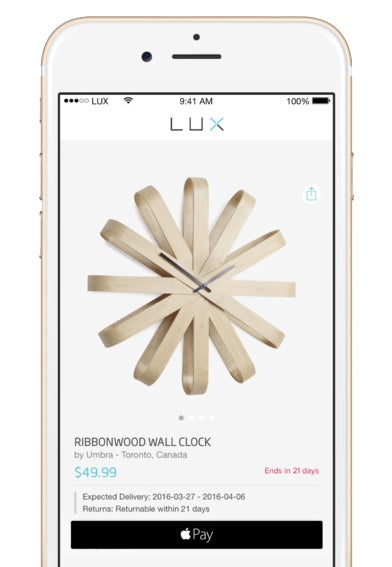
 If a picture is worth a thousand words, Lux is hoping video is worth a conversion.
The home decor and interior design shopping app, which launched July 2015 on iOS and Android, sees a 30% higher engagement rate on autoplay video than on static product photos.
“Facebook has proven that autoplay video can be quite successful,” said Lux COO Kyle Jiang. “We think that something like 95% of our traffic is going to be driven by video in the next two to three years.”
As users scroll through the quirky home goods for sale on Lux – everything from solar-powered jar lamps to barbecue spatulas with a built-in flashlight for nighttime grilling – they’re presented with how-to videos interspersed throughout the feed that demonstrate how the products work. A team of two in San Francisco produces and shoots the majority of the videos in-house.
The aesthetic resembles the video content from BuzzFeed’s Tasty recipe channel, where a pair of hands dexterously prepares delicious-looking food with lots of flair, but little fanfare.
For its part, BuzzFeed is still killing it with Tasty. According to recent data released by video analytics company Tubular Labs, Tasty maintained its spot as the No. 1 most viewed cross-platform publisher in June with 1.8 billion views, mostly thanks to its aggressive Facebook strategy.

 Lux, which raised $3.5 million in Series A funding in June from IDG Capital Partners and FREES Fund, is also promoting its in-house videos on Facebook (of course), and it’s starting to bear fruit in terms of traffic, Jiang said. The sales are also starting to roll in.
“When there’s video involved, the conversion rate is around three times higher for the same product than when there isn’t a video,” he said.
Jiang claims some customers have actually made a small purchase, say an inexpensive kitchen item or smartphone gadget, on Lux within less than a minute after downloading the app and registering with their credit card information.
While the average ticket price is about $45, Lux wants to get users more interested in the bigger stuff, like furniture and outdoor equipment. One idea is to introduce a virtual-reality shopping experience that allows users to get a better idea of what an item looks like in the real (or almost real) world. Lux has already shot more than 100 VR photos and plans to distribute 1,000 VR headsets to its most valuable customers when it finds the right headset partner.
“The idea is to use mobile to either replicate, or perhaps even replace, the experience of going into an Ikea or a Pottery Barn,” Jiang said.
Lux rounds out its video strategy with lifestyle content around DIY crafts, home design suggestions, space-saving ideas for small spaces and Facebook live-streams on things like summer cocktail prep and tips for cutting down on clutter. A tab in the app aggregates content selected by Instagram and YouTube personalities – home stylists, chefs and lifestyle bloggers – who share posts about their favorite items.
Although it’s still early days for Lux – the app is still in growth mode with 290,000 installs so far – Jiang said he sees video as a competitive advantage.
“A lot of places, even Amazon and Wayfair, only have pictures,” he said. “But we’re finding that video really tends to get our customers to shop more.”
Since the launch, Lux has seen its conversion rate creep up from around 1.5% to 4%, roughly double the average for retail shopping apps. Jiang attributes the increase at least in part to Lux’s growing focus on video.
“There are a lot of companies out there trying to figure out how to get people to actually shop on their phones,” he said. “For us, it’s simple. It’s about the combination of video and an easy-to-use interface.”
This is the first installment of Home Screen, a series of profiles on mobile pubs and apps and the devs that make them (and hopefully make money on them). Read about teen voting app Wishbone, wedding planner platform The Knot, lip-syncing app Musical.ly, pop culture magazine Movie Pilot, news app News Republic, on-demand laundry app Cleanly, music streaming app LaMusica, P2P global shopping app Grabr, kid-friendly chat app Jet.me, driving app Dash, anonymous app Whisper, storytelling app Episode, weather app Poncho, online writing community Wattpad and sticker app Emogi.