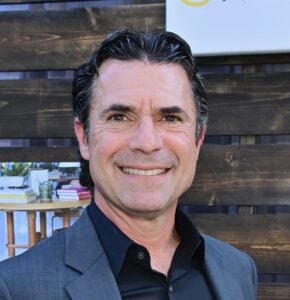

Sam Cox knows his way around the programmatic pipework of the internet.
He held senior product stints at OpenX and MediaMath, then did the same for the Google programmatic exchange group and the Amazon DSP.
In August, Cox joined Integral Ad Science as SVP of product management.
Before the pandemic, the breakneck pace of programmatic had slowed down, and people in the ad industry had a grasp of how things worked. All of a sudden, with third-party deprecation, regulations and privacy policies, online advertising is back in turmoil and in need of rapid re-education.
“That’s the fun part for me,” Cox told AdExchanger in an interview after he was hired by IAS.

AdExchanger spoke with him at more length.
AdExchanger: How do you feel about being back at a relatively small company (a mere $5 billion or so market cap) after Google and Amazon?
SAM COX: I’m excited to have an opportunity to move faster and to make a big impact on the company and on its partners. And to have a bigger say.
Whenever you’re inside those big companies (or companies that are that big), they are cultures and systems unto themselves. And they move at their own pace. They also oftentimes have a lot of conflicting and self-competing interests, you might say. It’s nice to have a little bit more liberty.
What would be your advice to a 20-something-year-old starting at a Google or Amazon in advertising?
Oh, man. I think of those places as “high-context society.”
Like in Japan, where you can make a mistake in manners without knowing it. You really have to not just understand your job and the problem you solve, but the culture of the place.
As you get higher up, I’d say the biggest challenge and the piece that requires the most effort and learning is figuring out the system itself. Because they really are their own their own ecosystems.
But that also can create a massive amount of myopia. And an unawareness of what is happening outside the company. There’s a tendency to be very inward-looking and not very customer focused.
It’s a time of turmoil for online advertising. What do you think of the current state of programmatic?
We have these secular headwinds across regulation, consumer privacy and where consumers are spending their time. And it actually opens up a lot of new possibilities. Any time you have a moment with this much change, there’s a lot that you can do.
Especially as we kind of go through the looking glass on privacy changes, we’ve seen lots of stuff deprecated from bid requests and other data. It’s going to change how we look at, measure and activate media.
Do you think IAS has fundamentally changed – with acquisitions of Amino Pay, Publica and [contextual data company] Context – from its original ad verification value prop?
It all still comes back to the question: “What are we measuring, and what’s important right now?”
Since Ads.txt, Ads.cert and Sellers.JSON, you’ve seen supply-path optimization, right? There was the growth of header tags before that. There are different and more types of fraud and misrepresentation.
Will we see an IAS DSP?
As I look at what’s changing in the industry, the buy- and sell-side pipes are commoditizing. And I think that that’s a really interesting evolution.
I haven’t been here long enough to say “yes” or “never,” though. But if you look at the big DSP platforms, they’re trying to open up more functionality and be the whole ecosystem that other companies can build on. I think that’s what The Trade Desk’s recent releases have been about.
There are a lot of different ways to add value to the ecosystem because people want diversity in the ecosystem. People are doing that through identity by bringing in contextual data or doing customer enrichment.
IAS works with pubs, advertisers, tech and data vendors, so how do you bucket or define those various stakeholders in terms of who are customers, partners or something else?
For the entire ecosystem, advertisers are customers, right? And I would call it actually the buyer. Since it can be the agent or person who represents the advertiser.
DSPs obviously work for the advertisers. We work with advertisers and other buyers. Publishers work for advertisers, right? Because they want to make sure that advertisers want to buy their media.
We all are in the media business. And that media business starts and ends with advertisers.
There are so many competing interests, so how do you align all those interests to make sure that everyone’s focused on the advertiser and everyone’s getting the commensurate value that they contribute?
I look at what’s going on with [made-for-advertising] MFA sites, and it’s about making sure that quality publishers that deserve it get paid. Vendors and advertisers respond to that. And helping those real publishers is also helping advertisers.
In the end, the person who signs the checks and puts the money in the top of the hopper, that’s the marketer.
*Editor’s note: take a quick moment of recognition for Pickles, a Very Good Dog – and one-time Programmatic IO attendee – who’ll be missed.
For more articles featuring Sam Cox, click here.