As more brands, agencies, and media companies join in on the AI chorus of “better, faster, smarter,” the teams administering AI tools are singing a dissonant tune — managing a growing stack of AI-powered tools layered across planning, activation, measurement, reporting, and workflow management. It’s a familiar irony to anyone in advertising: Another innovation designed to make the ecosystem easier is instead creating more systems, more interfaces, more costs, and more operational complexity.
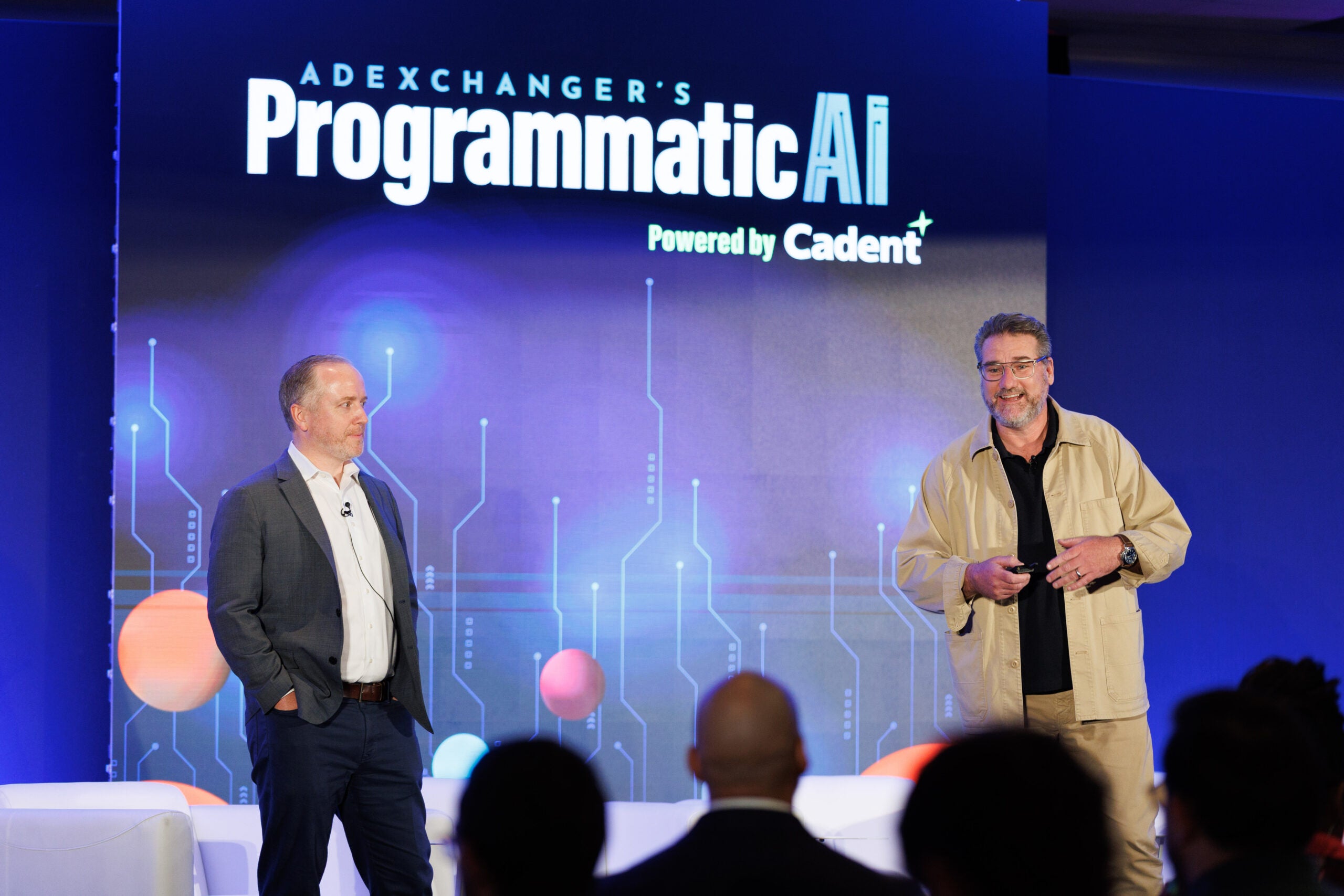
Last month at AdExchanger’s Programmatic AI 2026 event, Mike Rhodes, Director, Customer Engineering at Google Cloud, and Eoin Townsend, Chief Product & Technology Officer at Cadent tackled this irony — that the tools that promise efficiency and simplicity instead make day-to-day operations more difficult. The two leaders shared the stage and shared their vision for the next phase of AI that won’t be defined by bigger models or more assistants, but by how effectively organizations connect intelligence across systems, teams and workflows.
“What the industry doesn’t need is another AI product,” Rhodes said during the session. “The market is moving away from point solutions and toward the integration and orchestration of many different agents and workflows.”
AdExchanger spoke with Rhodes and Townsend about why so many AI initiatives struggle to deliver business impact, how advertising can avoid creating “smarter silos,” and what it will take to make advertising intelligence more actionable.
AdExchanger: Three years into the AI boom, why are so many organizations still struggling to get meaningful business value from AI?
Mike Rhodes: A big part of the issue is that many organizations have treated AI as another destination. They introduce a new tool or assistant and expect people to change how they work in order to see value. But most teams already move through too many systems every day.
The AI initiatives that succeed are connected to trusted data and the places where work already happens. Because the value of the answers these tools can provide only matters if those answers are delivered in the time and place where they can help someone understand context, make a decision, and actually take the next step.
Eoin Townsend: Advertising has an additional challenge, which is that the ecosystem was already fragmented before AI entered the picture.
We have a long history as an industry of taking exciting technologies and making them a lot more complicated than they need to be. Programmatic, identity, CTV, retail media — all of these created real value, but they also created more platforms, more dashboards, more workflows, and more complexity.
AI could make that better, but it can also make it worse. If every platform launches its own AI layer and none of them connect, then we haven’t solved fragmentation. We’ve just created smarter silos.
AdExchanger: Mike, you’ve said the industry doesn’t need another AI product. What does it need instead?
Rhodes: It needs connected intelligence. Advertising workflows don’t happen in isolation. Campaign execution affects measurement, measurement affects optimization and optimization affects audience strategy.
The problem is that intelligence often lives in disconnected systems. One tool understands reporting, another understands audiences and another sits inside a DSP or CRM.
But I want to make one clear point: I’m not saying the market is headed toward one giant AI assistant that does everything. It’s coordinated intelligence: different agents and systems working together across workflows. That’s why orchestration matters as much as the model itself.
AdExchanger: Eoin, why is advertising especially vulnerable to creating more complexity with AI?
Townsend: Because we’ve largely just accepted complexity as normal for a very long time. Ad tech has become intimidating, and we in the industry almost have a perverse pride about that.
For years, we’ve expected users to learn the architecture of the ecosystem in order to get value from it. You need a translator to understand all the acronyms, platforms, and workflows. And so, historically, a lot of this advertising intelligence has been locked inside expert workflows. You had to know where to click, how to filter, which reports to reconcile, and who to ask.
That’s not sustainable. A sales leader shouldn’t need to understand every part of a DSP to know whether a client’s campaign is underdelivering. An executive shouldn’t need to ask five different teams for updates to understand where the business needs attention. And an account manager shouldn’t have to wait for a report to know which audiences are performing well.
Conversational AI changes that by allowing people to ask these business question directly.
But we need those answers to be grounded in the right data and the right advertising logic. Otherwise, it’s just a polished response sitting on top of a fragmented system.
AdExchanger: The Cadent-Gemini integration is the news hook here. What problem were you trying to solve by bringing Cadent intelligence into Gemini Enterprise?
Townsend: The goal was to meet users where they already work. Most organizations are putting large language models at the center of the employee experience, so instead of asking people to learn another platform, we wanted them to access Cadent intelligence through a familiar environment.
If someone wants to know which campaigns need attention or which audiences are outperforming, they should be able to ask that question directly — not open multiple tools and manually stich together an answer.
The integration is the headline, but the bigger story is the infrastructure work underneath it. We spent the past year unifying data, signals, and systems so the AI layer is built on a foundation that can support meaningful answers.
Rhodes: That last point is really critical. Our philosophy is that the machine should adapt to the user — not the other way around.
That’s even more important in advertising because decisions happen so quickly. Teams are managing pacing, optimization, reporting and client communication simultaneously. They don’t have time to jump between systems.
Bringing advertising intelligence into Gemini makes it part of the workflow people already use, allowing them to move from question to context to action with less friction.
AdExchanger: Everyone in AI talks about models. Why the emphasis on infrastructure?
Rhodes: Because infrastructure determines whether AI can work reliably at enterprise scale.
Models are going to keep changing. We’ll keep seeing new capabilities and new debates about which model is best for which task. But enterprise success with AI won’t fall along the lines of specific models. It’s going to come down to smart orchestration.
That means trusted data, secure access, permissions, governance, cost efficiency, and the ability to coordinate workflows across systems. In advertising, where margins, speed, and scale matter, those details are what make AI practical.
Townsend: Here’s the thing: Anyone can build an AI tool on top of a platform, but the harder work is making sure the underlying platform is ready for AI. And if you build an intelligence layer on top of fragmented data, you’re not going to get a very effective intelligence layer.
That’s why, at Cadent, we’ve brought together multiple companies and capabilities over time — a lot of our work has focused on reducing friction across that larger system.
The point is that the foundation matters — at least as much, if not more than, what you build on top of it. You need the data connected, the signals connected, and the agents built in a way that doesn’t create redundant processing or unnecessary cost. Otherwise, you can build something that looks impressive in a demo — but is too slow, too expensive, or too disconnected to run in the real world.
AdExchanger: Who benefits most when advertising intelligence becomes easier to access?
Townsend: Everyone across the organization that now has direct access to intelligence. Sales teams can understand what’s happening with clients. Account teams can prepare for conversations. Executives can see where risk or opportunity sits. Agency partners can move quickly without waiting for multiple reports or handoffs.
It’s important to say that the specialists still matter enormously. Traders, analysts, campaign managers, and yield teams need advanced tools and detailed controls. That doesn’t go away. But the benefits come from giving more people access to the information they need, in a way they can actually use.
Case in point: When we launched this internally at Cadent, one immediate thing we saw was that salespeople no longer had to go to a campaign person for every performance question. They could ask Gemini and get grounded answers from Cadent’s data. That changes the way our sales team operates because intelligence is no longer trapped inside one function.
Rhodes: I think that story shows the real promise of agentic AI. We’re talking about operational leverage instead of simple automation.
If you put AI in the hands of more people, and it’s connected to the right data and workflows, organizations can finally start to get the “better, faster, smarter” benefits the AI advocates have been shouting about for years now. People spend less time searching, reconciling and translating information across systems. They spend more time making decisions.
AdExchanger: Looking ahead, what does success look like for AI in advertising?
Rhodes: Success means AI becomes less visible. Instead of being another tool, it becomes part of how work gets done — connecting data, workflows and decisions across the business.
At the company level, the organizations that succeed will be the ones that can coordinate across systems and use AI to meaningfully reduce friction instead of just adding another layer of it.
Townsend: For me, success looks like making advertising easier to work with. Advertising isn’t going to become less complex overnight. But people shouldn’t have to navigate that complexity every time they need an answer.
The bottom line is that a lot of cool technologies never really took off because they weren’t practical, even if they were genuinely helpful and offered real value. The best technology — the innovations that really change how we work and live — is, at its core, easy to use and easy to fit into the way you already do things. That’s what we need to focus on with AI. If we’re building AI solutions that help organizations become more informed, more connected, and more capable — without forcing everyone into another dashboard — then we’re moving in the right direction.
For more articles featuring AdExchanger Content Studio, click here.