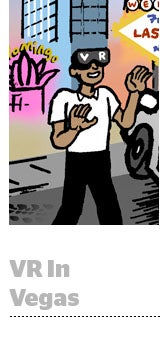
 Everyone at CES 2016 has seen it all before.
Like last year and the year before, there are flatter televisions, displays bright enough to melt your face and the most aggressive gathering of people to ever combine lanyards and khakis. But even if no new gizmo is combusting the collective mind here in Las Vegas, there is incremental evolution of products that might eventually have a significant impact on marketing and advertising, the most notable of which is virtual reality (VR).
If you’ve got $599 burning a hole in your pocket, you can pre-order Facebook’s Oculus Rift. Oculus, in case you forgot, is the VR company Facebook acquired for $2 billion in 2014.
The purchase includes the Rift, which is the hardware headset, and, of equal importance, the Oculus platform, which is a marketplace for VR apps. In other words, a forum where people can actually get VR content, so they don’t end up using the Rift as a doorstop.
At that price point, the Rift is obviously more specialized. But Samsung already offers its $100 Gear VR, compatible with Samsung phones. Yes, Amazon and Best Buy reportedly sold out of Gear VR devices for the holidays, but it’s still unclear what sort of experiences will entice consumers to strap a block of plastic to their faces with any degree of frequency.

Regardless, agencies are advising brands to at least start paying attention to a technology that a few years ago was mostly deployed in science fiction.
“Two years ago, I’d bring VR in as a concept to our clients and I’d get laughed out of the room,” said Bhavyesh Maroo, SapientNitro’s director of technology.
VR has the opportunity to proliferate because the ecosystem is maturing. As mentioned, Oculus has the means to distribute VR content. Google and Facebook are both beginning to offer 360-degree videos that take advantage of a mobile handset’s accelerometer. And the means of producing those videos is becoming cheaper, as 360-degree cameras start to come into market.
And, of course, the VR headpiece is now in market.
“[Samsung’s] Gear VR is the first accessible consumer product in the market,” said Adam Simon, director of strategy at IPG Media Lab. “Before, there was no point designing a social experience.”
IPG’s clients, he said, are at least curious about it, and VR is potentially “the next major medium.”
In August, Discovery rolled out its app, DiscoveryVR, for Android and iOS devices. Without a VR headset, it’s basically a portal for 360-degree video. With a VR headset – nominally that would mean GearVR on a Samsung device (which is what Discovery demoed at CES) – it becomes fully immersive.
And Discovery is actively going after advertiser partners. So far, it’s had one.
“We’re going to do stuff with brands for sure,” said Scott Felenstein, EVP of advertising sales at Discovery Communications. There are two ways this is happening: Discovery will either produce branded VR videos, or it will embed the brand somewhere in its existing 360-degree videos.
“We were just talking to somebody who’s got a golf club academy,” Felenstein recalled. “He said it would be great to get a professional golfer as a sponsor to play a round with a new set of golf clubs. Or you could do a test drive with an automaker.”
Before everyone decides to take a high-speed ride on the VR hype train, however, there’s still a lot that content makers, brands and agencies need to figure out. The technology is new and promising, but it’s still unclear how consumers want to interface with it – assuming they don’t treat it as a fad.
Once best practices around VR emerge, the process of creating those experiences can be “templated,” said Maroo. When that happens, producing VR applications will be less of a one-off experiment. (As an example of a one-off, Twentieth Century Fox had an interactive VR experience using the Oculus Rift, centered around the movie “The Martian.”)
Carrie Seifer, president of digital, data and technology at MediaVest, added that brands are still figuring out how to value VR experiences.
“We’re just getting started with consulting our brands through potential tests they can do that’s part of the content creation – or pre-roll in the 360-degree experience,” she said. The liquor category, she added, is particularly interested. One hurdle: Traditional brand KPIs like awareness are difficult to test following a VR deployment.
Which brings us to the data that, for Maroo, is very promising. “VR gives you so much more data than any other medium,” he said. “You get full playback of the experience. I can tell exactly what you were gazing at.”
But the data, he said, sits with the device manufacturers: “Unlocking it is the key.” Which is why he says Facebook is in a very advantageous position.
Google might have Cardboard, but Facebook, with Oculus, owns the hardware and the distribution mechanism. And it would be unlike Facebook not to try to monetize those assets.
VR is still a novelty at the moment. Content exists, but not a lot. The Oculus Rift is expensive and nichey. GearVR only works with Samsung phones. And no one – except maybe Google – knows what’s going on with Cardboard.
But the technology has at least started to creep into consumer living rooms. As it matures, industry insiders expect the Oculus Rift to come down in price, especially as other VR headsets come into market.
“We’re watching PlayStation VR closely,” Simon said. “We were hoping Sony would give us a price and release date at CES. They did not. We don’t know a lot about it, but the PS4 has a 40 million install base.”
Other bits and pieces
It’s hard to write about IoT as a new thing, but sticking with the theme of incremental evolution, CES did showcase some small but notable deployments that facilitate an era of connected … well, everything.
First up was Ford integrating with Amazon Alexa – the personal assistant you can query and use to order items you’ve ordered in the past.
This is worth musing about because it demonstrates how personal assistants are making their way into new places – ultimately becoming devices by which consumers manage their lives.
That scenario is still years out, but Maroo wondered about the monetization of content within Alexa. “When we buy detergent, what brand and at what price point are we looking for? What influences that digital assistant? How does that get opened for marketers?”
Another example: Groceries By MasterCard, a project that embeds home-delivery grocery services ShopRite and FreshDirect into the Samsung Family Hub refrigerator, scheduled for availability in May. MasterCard developed the ordering app, factory-installed in the appliance.
Again, it’s a small deployment and not likely to be widely adopted immediately, but it represents a notable IoT consumer deployment. If anything, it caught the attention of Shingy, AOL’s eccentric brand ambassador, who skittered up to it to show to a crowd of Procter & Gamble innovation execs.