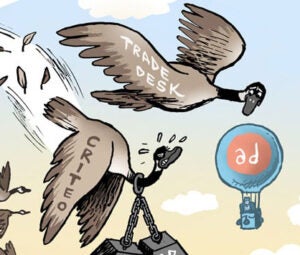
What exactly is going on with Google and the providers of data-management platforms (DMPs)?
As AdWeek reported in early October, Google will begin enforcing a rule prohibiting DMPs from firing tracking pixels on ads running through the Google Display Network unless that DMP also owns the demand-side platform (DSP) buying the impression.
This rule is listed in Google’s support page for third-party ad serving and states that tracking mechanisms from certified third-party vendors may be used for certain purposes, but “[c]ollecting impression-level data via cookies or other mechanisms for purposes of subsequent re-targeting, interest category categorization, or syndication to other parties on Google Display Network inventory is prohibited.”
As it affects DMPs, a DMP-DSP hybrid, like Turn, could fire a tracking pixel without a problem. But Turn’s DMP cannot fire that tracking pixel if another vendor’s DSP makes the ad buy, since that requires the DMP send data to another party – the DSP.
This means DMPs that don’t bundle with DSPs, like Krux, Neustar, Lotame, BlueKai – really, most of the DMPs on the market today – will have blind spots on the Google Display Network. And companies like Turn will, too, since many of its clients use DSPs from other providers.
Google began notifying vendors of its decision Oct. 1, giving three months of prep time before it begins enforcing the rule, according to DMP providers affected.
Whether one characterizes Google’s decision as a change in policy (DMP providers’ point of view) or as tightening enforcement of existing regulations (Google’s point of view), certain vendors who thought they were in compliance will find by Jan. 1 that they aren’t.
Or, in the words of Krux Chief Solutions Officer Mike Moreau: “There are a lot of pixels that have been certified that will be decertified as of Jan. 1”

Customer Impact
If Google restricts pixel firing, then DMPs and their clients will lose visibility into activity on the Google Display Network.
For DMPs like Neustar, whose technology powers holding company Omnicom’s analytics engine, Annalect, this is going to be a problem because “Omnicom doesn’t want blind spots from a measurement perspective,” said Rob Gatto, Neustar’s SVP of media and advertising. Without tracking pixels – or a viable substitution – Omnicom won’t be able to gauge performance on Google sites with relation to non-Google sites.
For Krux, Google’s decision could cripple its ability to provide global frequency management services – the ability to cap how many times a certain consumer sees an ad. “This reduces media waste and lets [advertisers] reach more people at the optimum frequency rate,” Moreau said.
So a client buying inventory with multiple DSPs won’t have visibility into consumer activity around ads running through Google Display Network, limiting the ability to optimize how often an ad is shown.
Is Three Months Enough?
Google has been working closely with DMPs in order to find a mutually beneficial fix to the problem. And representatives from two DMP providers – Neustar and Krux – agree with Google’s rationale and long-term strategy behind the policy enforcement but question the method.
“I think pixels are the wrong way, long term, to do [tracking],” Gatto said. Tracking pixels, he said, don’t work in mobile. Additionally, many in the advertising industry are looking to move on from the technology.
But Google’s decision to tighten its enforcement regimen by January is too much too soon for DMP vendors. Google’s proposed substitution for tracking pixels is APIs that transfer data back to the DMP.
Google and its partners are still working out the details of the API, but vendors wonder if it will provide the same amount of information available through tracking pixels.
“Their proposed solution is incomplete and doesn’t get our clients everything they need,” Krux’s Moreau said. “We are talking to Google about how they get there, but there isn’t a clear path yet.”
The problem with data transfer files, Moreau said, is that the DMP needs to do cookie matching in order to leverage that information.
“Which Google allows us to do,” Moreau said. “But as a marketer, you’d have to have that user in one of your segments. If a user doesn’t come to your website but you see that user somewhere across the Google Display Network, there’s no way to do that matching so the data transfer files are usable.”
For Neustar’s Gatto, it’s a matter of ensuring enough actionable information comes through with the data transfer.
“Not every data element we pull from the pixel today exists in the API,” he said. IP address, for instance, isn’t available in the API but it’s an additional piece of location information delivered via tracking pixel.
The heart of the issue is that Google wants DMPs to consume information a certain way, and the DMPs want to make sure that Google’s alternative provides them with the same depth of information they get from tracking pixels. They also want to make sure they can get that information when they need it – for instance, if the API only pushes information through once a day, that’s too slow for a lot of DMP clients.
While Google, by all accounts, is working closely with vendors to answer the numerous questions they have, partners are skeptical the three-month countdown provides enough time.
But What’s Wrong With Pixels?
The problem with many banner ads is that they’re stuffed with too many tracking pixels.
This bloat increases the possibility of audience data leakage, which many vendors believe is Google’s rationale for its regulatory tightening.
“Usually that data leakage is controlled contractually, but the more tracking pixels that run in an ad unit, the more difficult it is to enforce and ensure there’s no leakage,” Gatto said.
“If [Google’s] desire is to reduce data leakage or to have fewer pixels firing, I think that’s a wonderful thing,” Moreau agreed, although he reiterated his concern that Google’s methods might not “be best for our clients.”
The reason data leakage is bad for Google – and for publishers in general – is that it provides the means for advertisers to find an audience on one of Google’s sites, then buy that same audience elsewhere for cheaper.
And this is where Google and the DMPs potentially have a conflict. “When you think of the classic DMPs on the market – BlueKai, Lotame, Krux – they’re all in the business of buying and selling data,” said Gatto, noting that although Neustar also buys and sells data, its measurement and data disciplines are separate.
Krux’s Moreau disputed Gatto’s characterization of his company, saying: “At Krux, we don’t buy or sell data and we don’t buy or sell media.”
These nuances and disagreements over who buys and sells data could be among the reasons behind Google’s wholesale crackdown. Moreau would have preferred Google create a recertification program and take time understanding the business practices of each DMP provider. But rapid consolidation among DMPs (Neustar buying Aggregate Knowledge, IgnitionOne buying Knotice, Rocket Fuel buying [x+1], etc.) would make business model oversight an ongoing process.
And considering the DMP providers don’t agree on which of them buy and sell data, what chance does Google have?