 “Data-Driven Thinking” is written by members of the media community and contains fresh ideas on the digital revolution in media.
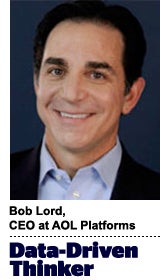
Today’s column is written by Bob Lord, CEO at AOL Platforms.
While the term “disruption” has become a bit of a cliché, there’s no denying that technology is radically reshaping the ad industry. Investments in programmatic-powered ad campaigns are climbing, enabling agencies, brands, publishers and even broadcast players to realize significant value from automation.
And as programmatic technologies continue to evolve – fueled by increasingly massive amounts of data – the benefits will move far beyond just process efficiencies to impact every aspect of advertising, from media selection and creative execution to how TV advertisers serve data-enhanced campaigns.
With all of this in mind, I expect to see three developments in 2015.

Brand Advertisers See The Fruit Of Programmatic Investments
In 2014, brand advertisers and agencies invested heavily in programmatic, incorporating automated systems and processes up and down their marketing organizations to drive efficiency and impact. In 2015, those investments will begin to see significantly greater ROI.
Having bought in to the promise of programmatic, advertisers are now experimenting with different solutions and choosing technologies that support their businesses in a more streamlined manner. For example, more marketers are simplifying their buying strategies, moving from managing dozens of technology tools to consolidating all of their efforts into one or a few core systems. Baking in a unified architecture now allows their teams to focus on how to maximize their ROI moving forward. The early bird indeed gets the worm: Advertisers late to adopt programmatic can go ahead and sleep late.
So, if 2014 was the “tell me” year for programmatic, 2015 will be the “show me” year, where beneficial results will become even more pronounced and show greater brand lift and incremental sales.
Most TV Companies Begin Employing Audience-Driven Programmatic Selling
TV is still the largest and most powerful ad medium, as evidenced by the $70 billion eMarketer estimates it still rakes in. But TV is on the verge of experiencing meaningful disruption.
The technology to power automated, data-driven ad decisions, campaign optimization and measurable attribution – enjoyed by digital for many years – is now available for TV. The integrations with legacy systems to enable end-to-end automation are being developed.
In 2015, we will see broadcasters, cable networks and multichannel video programming distributors begin to open their systems, adopt programmatic technology and transact on more precise audience segments – beyond just age and gender – to expand the value of their TV programming.
“Today, convergence is the new reality,” Linda Yaccarino, NBCUniversal’s president of advertising sales, said during Advertising Week. “Programmatic is here to stay. … Content, distribution and data are critical, but what’s even more critical is the need to bring them all together.”
This will align with the overall ad industry’s movement toward data-driven marketing, enabling advertisers to seamlessly plan, buy and measure their spending across all screens and understand what is driving ROI – all from one platform.
Forward-Thinking Brands Insist On Data Ownership
One of a marketer’s most valuable assets is data. It’s at the core of every decision that fuels their business. Smart brands will become increasingly aware of the negative impact of “giving away data” and recognize the real need to own it.
The reality is that some large third parties often take ownership of a brand’s data. This “walled garden” inhibits brands from accessing critical data, including facts as core as who saw their ad or clicked on it. This situation also cripples a brand’s ability to develop accurate campaigns in the future, as data analytics is an evolutionary process where the results of each campaign inform the next.
In 2015, we can expect advertisers to start asking tough questions of their providers and, to the extent possible, take complete ownership of their data. We will soon reach a tipping point where brands demand that their campaign data not reside in a third-party black box.
When it comes to advertising technology, the industry has moved well beyond a wait-and-see approach. Powered by data, programmatic platforms and ever more advanced analytics, we are rapidly moving full steam ahead, across all media channels.
Follow Bob Lord (@rwlord), AOL Platforms (@AOLPlatforms) and AdExchanger (@adexchanger) on Twitter.