

“Data-Driven Thinking” is written by members of the media community and contains fresh ideas on the digital revolution in media.
Today’s column is written by Jay Friedman, president and partner at Goodway Group.
As 2018 comes to a close, we’ve seen a number of positive trends giving ad tech more hope than ever moving into 2019, including major advances in technology and rebuilding marketers’ trust with greater transparency and control.
Of course, challenges still exist, including regulations, consolidation and the need for marketer education, to name a few.
So take a break from wrapping up all of those last-minute projects for the year and making sure those campaigns deliver in full, and let’s look back at the past year and where we stand in ad tech today, as told in GIFs.


General Data Protection Regulation (GDPR) and Intelligent Tracking Prevention (ITP) take center stage
The big story of 2018 was undoubtedly GDPR and its impact on the ability to target users based on their browsing habits. Between GDPR and ITP, Apple’s iPhone feature that makes effective retargeting next to impossible in Safari, we went from users experiencing never-ending ad retargeting, much like Ace Ventura’s never-ending demonstration of sound-proof glass …
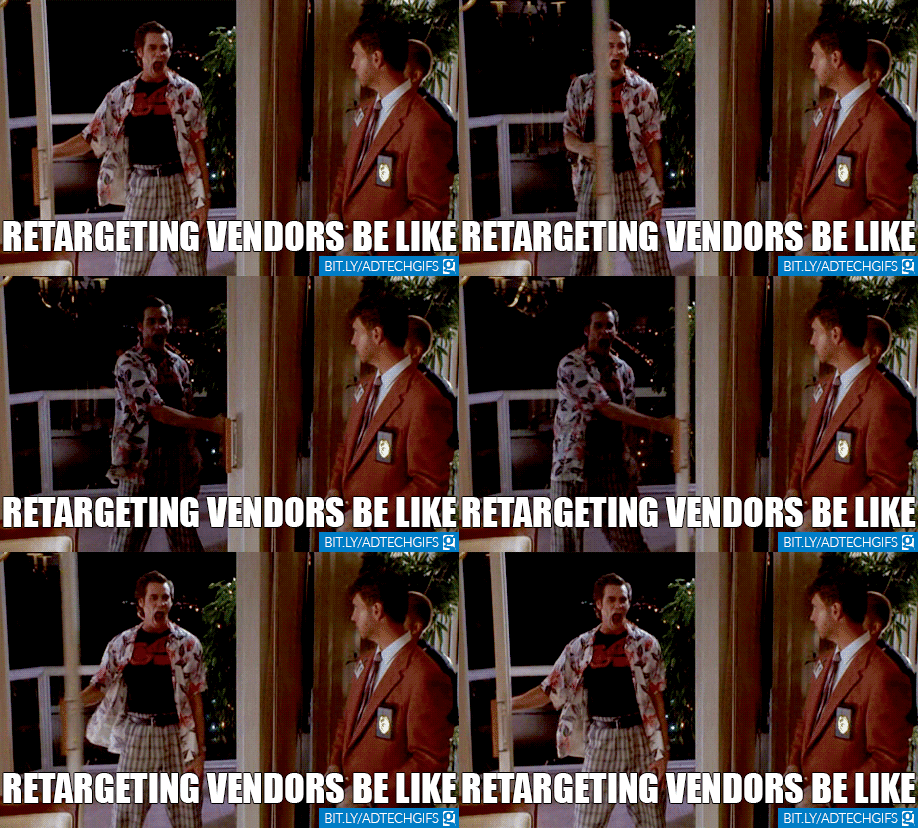
… to being legitimately excited when a user gives proper consent under GDPR guidelines.

Consolidation accelerates; black magic decreases
For nearly 10 years, many selling ad tech kept their “secret sauce” close to the vest.

If you had asked any media buyer, they would have told you Rocket Fuel’s famous line …

And now we know why. No more. The reason for all that “performance” wasn’t proprietary after all – it came from client data that was commingled when it wasn’t supposed to be.
That lack of transparency is one of many well-documented reasons why Rocket Fuel was sold off, later to be consolidated within Sizmek. Today the consolidation trend continues, for many reasons: Adaptly was sold to improve workflow at Accenture, for example, a far cry from its original mission. AT&T bought AppNexus, IPG acquired Acxiom Marketing Services, and LiveRamp is still on the block.
Other companies faced mortal threats: Collective Media (later Visto) and Yieldbot filed for bankruptcy or closed their doors, respectively.
Fewer ad tech companies in the space is ultimately a good thing.

Now agencies and marketers can focus on real strategy and business outcomes.
Walled garden wall-i-ness has only gotten worse
Every walled garden loves to claim credit for every conversion it touches. But it’s just not reality.
There are touchpoints across the entire internet, not to mention across all media, yet some think Facebook should be credited for a conversion when Facebook – or any walled garden – only achieved a frequency of one with a user.

Marketer education lags
While marketers have certainly grown smarter, the following GIFs were inspired by some of the more head-scratching requests we’ve received at my company over the past year.
My conversations with holding company executives, for example, reveal that most client pitches are still driven by marketers’ desire to get media and the service layer at a lower cost. In the pursuit of cost-effective alternatives, marketers still make unrealistic requests.

To understand why this isn’t the best strategy, being a marketer today requires not only technical sophistication but also a strong understanding of auction dynamics. It’s complex stuff.

Another common misconception we still address is that site analytics tools make good media measurement tools. Google Analytics is a tremendous site visitation measurement tool, but that’s it. It measures site activity and was never meant to be a media measurement tool. Sure, it works for pay per click (PPC) because every penny spent relates to a click. But, clicks aren’t what make display or video (or linear TV or outdoor billboards, by the way) ads work.
Too many marketers asked us this year why Google Analytics says programmatic isn’t performing as well as PPC or email. That’s just not the best use of Google Analytics.

And speaking of PPC, we still encounter the mindset that paid search is a promotional versus evergreen media channel. Since consumers search for brands and products year-round and not just during active promotional windows, it is important for marketers to adopt an always-on strategy.

In 2008 we talked to our clients about digital in traditional measurement terms, such as targeted rating points (TRPs), because at the time it was easy and comfortable. Surely, we should be past this in 2018? Clearly, we’re not, as we’re still often asked how digital fits into overall TRP goals.

With the evolution into people-based marketing, we can now execute media with the understanding that females 25-54 years old, for example, are not a homogeneous group. Sophisticated marketing is now measured on a one-to-one basis, and measuring reach across an arbitrary demographic group has become obsolete.
Happy new year! For more fun and merriment, check out more gifs here.
Follow Jay Friedman (@jaymfriedman) and AdExchanger (@adexchanger) on Twitter.








