 “Data-Driven Thinking” is written by members of the media community and contains fresh ideas on the digital revolution in media.
Today’s column is written by Hagai Shechter, CEO and founder at Fraudlogix.
Online ad fraud is a problem nearly as old as the online advertising industry itself. By now the existence of fake traffic, including bots and ad stacking, is hardly newsworthy. And while the industry has taken steps to eliminate it, the burden of responsibility for improving traffic quality has fallen more heavily on some than others, which may limit the ability to forge a successful defense.
To date, approaches in countering ad fraud have been largely of the “yank-it-out-by-the-root” variety, which certainly has merit. Looking to the supply side and weeding out the publishers directly responsible for specific instances of fraud is an important step in the right direction, but this course of action only gets us so far.
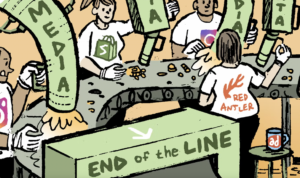
Fraud is so deeply embedded in each facet of the online advertising ecosystem that, while it may seem counterintuitive, it’s become a contributing factor – and possibly even an essential factor – to the short-term success of well-meaning participants.

A managed demand-side platform (DSP), for example, may have taken the initiative to audit its own traffic quality. It has identified a number of fraudulent traffic partners, or at least partners that are complicit in fraud, and begun the process of cleaning up its supply. As its traffic quality improves, its cost per mille (CPM) increases because real traffic costs more than fake traffic.
This continues until it reaches a certain critical mass of real traffic above which it will price itself out of business. Advertisers, as a rule, tend to favor lower CPMs as they give the impression of a greater ROI, and the DSP must compete with its peers for the same advertisers. Thus, given the current KPI demands of most advertisers, the managed DSP may be tempted to blend in a small portion of “questionable” traffic, as would the supply-side platforms it buys from and the publishers therein, and so on down the supply chain.
Perverse Incentives
This collective trend toward improving traffic quality – but only up to a point – occurs in part because advertisers’ success metrics are skewed to a fraud-ridden market. The advertisers are used to working with and around the fraud. They expect it, and their target metrics are calibrated accordingly.
This is especially true of branding efforts, where the real measure of a successful campaign is an intangible, and advertisers must rely wholly on stand-ins, such as CPMs and click-through rates, to track a campaign’s performance. CPMs would likely be lower for a campaign with some fraud in the mix, while click-through rates can also be faked and would be enticingly higher, but not too high, for the fake traffic that manages to make the cut.
Other KPIs similarly appear to be optimized by the inclusion of a certain level of fraud. A campaign with a small but significant quantity of fake traffic would outperform on paper a campaign comprised entirely of real traffic. This exposes an inherent bias in how we think about fraud prevention: Advertisers are unwittingly as complicit in the prevalence of fraud in the marketplace as the networks and publishers further down the supply chain that have been under pressure to clean up their acts by these very same advertisers.
The catch is that the advertisers, understandably, are not aware of their involvement while their performance metrics unintentionally guide them to eliminate only some of the fraud, but not all.
Adjust KPIs
There may not be a one-size-fits-all magic bullet of a solution, but there are positive shifts that can be made now, in addition to ongoing efforts. Advertisers can begin with adjusting their KPIs to anticipate the reality of a fraud-free marketplace.
They can turn to their cost-per-action campaigns, where conversions serve as a more concrete proof of success. If they compare the accompanying metrics for these campaigns, such as the average time on site or the relationship of CPMs for successful campaigns to CPMs for failed ones, to the same metrics in a branding campaign, they would see much more realistic indicators of performance than the benchmarks they’ve come to expect. We need a new measuring stick.
I say “we” and not “they” to stress the need for fraud prevention strategies to be an increasingly cooperative and collaborative effort if they’re going to be fully effective. Participants at every tier of the market – advertisers, the buy side, sell side and publishers – should acknowledge the need for their own involvement. Once we all agree it’s on everyone to stomp out ad fraud for good, and not just the traffic partners, the industry will be poised to make significant, lasting progress.
Follow Fraudlogix (@Fraudlogix) and AdExchanger (@adexchanger) on Twitter.